



Slug Pulling Prevention in Stamping Dies: Causes and Fixes
Slug pulling occurs when a pierced slug remains attached to the punch and travels upward during the return stroke. The slug may stay on the punch face, drop back onto the strip, become trapped near the stripper, or return to the working area where it can be struck again.
Effective slug pulling prevention in stamping dies starts with identifying what is holding the slug to the punch. Common mechanisms include vacuum, lubricant adhesion, residual magnetism, burr clamping, unsuitable punch-to-die clearance, worn cutting edges, and insufficient die-wall retention.
Izin, penyelarasan, die construction, and cutting-edge maintenance are broader tooling fundamentals covered in the Panduan Cetakan Meninju (disimpulkan). This guide focuses specifically on diagnosing slug pulling and matching the correction to its actual cause.
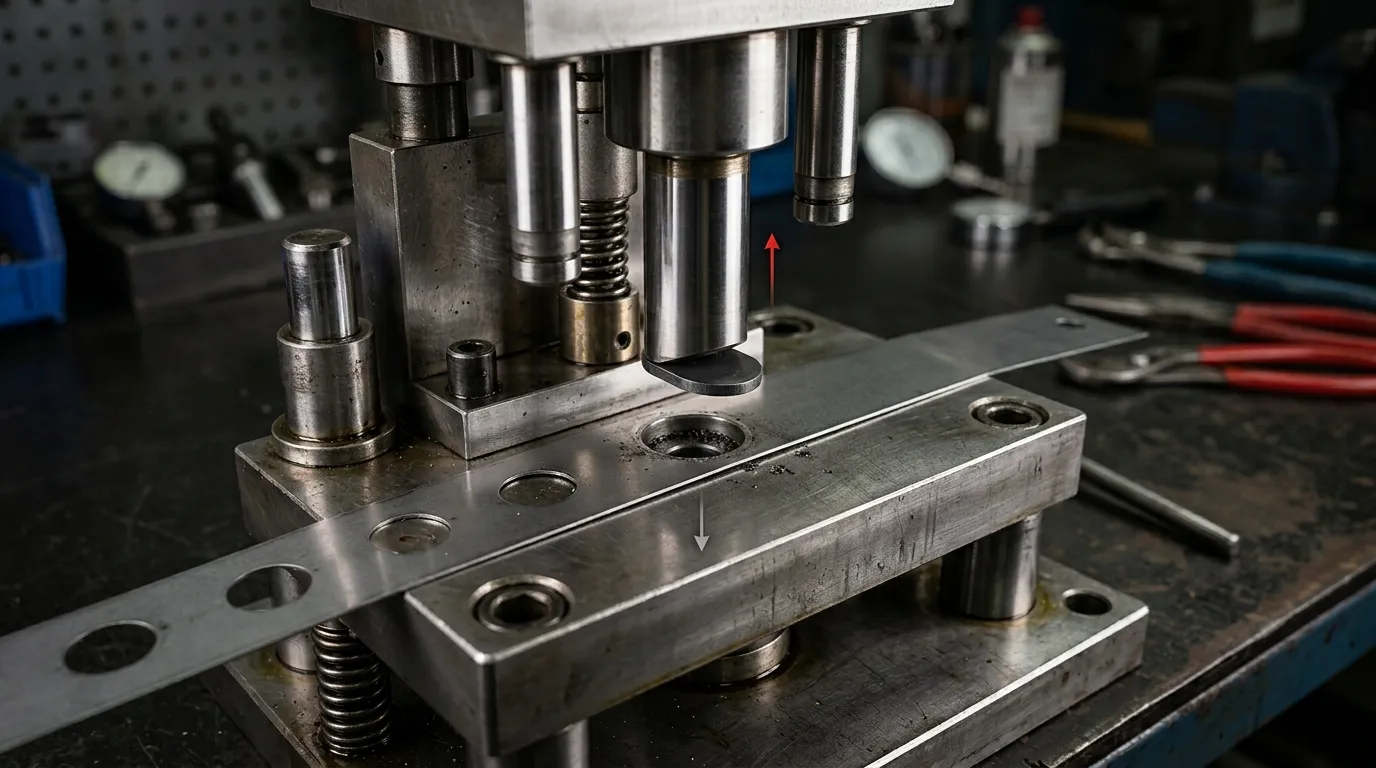
Seperti Apa Slug Pulling dan Mengapa Dapat Merusak Die
During a normal piercing cycle, the punch enters the sheet, separates the slug, and pushes it into the die opening. As the punch retracts, the stripper holds the sheet down while the slug remains in the die channel or continues through the relief area.
With slug pulling, the separated slug follows the punch during retraction. It may remain attached for the full upstroke or release unexpectedly above the die surface.
Typical signs include:
- A slug stuck to the punch face.
- Loose slugs appearing on top of the strip.
- Circular or shaped dents near pierced holes.
- Repeated slugs around the stripper or die surface.
- Feed interruption after a piercing station.
- Unusual impact noise during a subsequent stroke.
- Cutting-edge marks that appear after a double hit.
- Intermittent defects that occur only at normal press speed.
A returned slug can be struck between the punch and strip during the next cycle. This may mark the part, chip a cutting edge, overload a small punch, or interrupt strip movement in a progressive die. If repeated impact is contributing to tool failure, the related kerusakan pukulan pada cetakan stamping guide covers the broader fracture and overload mechanisms.
Konfirmasikan bahwa masalahnya adalah penarik siput yang benar
Not every slug found near the die surface was carried upward by the punch. Identifying where the scrap becomes uncontrolled prevents the wrong corrective action.
| Kondisi | Apa yang terjadi | Pengamatan khas | Area utama untuk diselidiki |
|---|---|---|---|
| Penarikan siput sejati | Siput tetap menempel pada pukulan selama penarikan | Siput terlihat di permukaan pukulan atau dilepaskan di atas strip | Gaya menempel pukulan ke siput dan retensi die |
| Penumpukan siput | Beberapa siput terakumulasi di dalam saluran die | Increasing discharge resistance, blocked relief, compressed slug column | Die land, relief, outlet, and scrap path |
| Siput jatuh atau memantul kembali | Siput terpisah tetapi bergerak tak terduga setelah dilepaskan | Siput lepas ditemukan di dekat cetakan tanpa bukti pemasangan pukulan | Geometri keluar mati dan kontrol skrap |
| Skrap mengambang | Detached light scrap returns to the working area through airflow, getaran, or poor evacuation | Potongan longgar bergerak secara independen dari pukulan | Chutes, outlets, airflow, and scrap handling |
Slow-cycle observation may reveal where the slug releases, but some failures only occur at production speed. High-speed video, where available, can show whether the slug follows the punch, pauses in the die opening, or becomes loose after discharge.
Other useful clues include:
- Oil patterns on the slug or punch face.
- Metallic debris or deposits around the cutting edge.
- A noticeable magnetic attraction between the punch and slug.
- Changes that began immediately after sharpening.
- A failure that appears only after increasing press speed.
- A slug that is already detached before it reaches the die surface.
Scrap suction can help remove detached light scrap, but it does not directly release a slug that is still attached to the punch. Component roles such as the punch, Tombol, stripper, guide elements, and wear parts are covered more broadly in the Panduan Komponen Die.
Mengapa Siput Mengikuti Pukulan Selama Retraksi
Slug pulling is best understood as a force-balance problem. Forces holding the slug against the punch act against forces that retain the slug in the die or push it away from the punch.
Menurut penelitian peer-review tentang mekanisme penarik siput, the dominant mechanism can change with punch diameter, pembersihan, penetration depth, cutting speed, lubricant viscosity, kondisi tepi, and material behavior. Several mechanisms may also act at the same time.
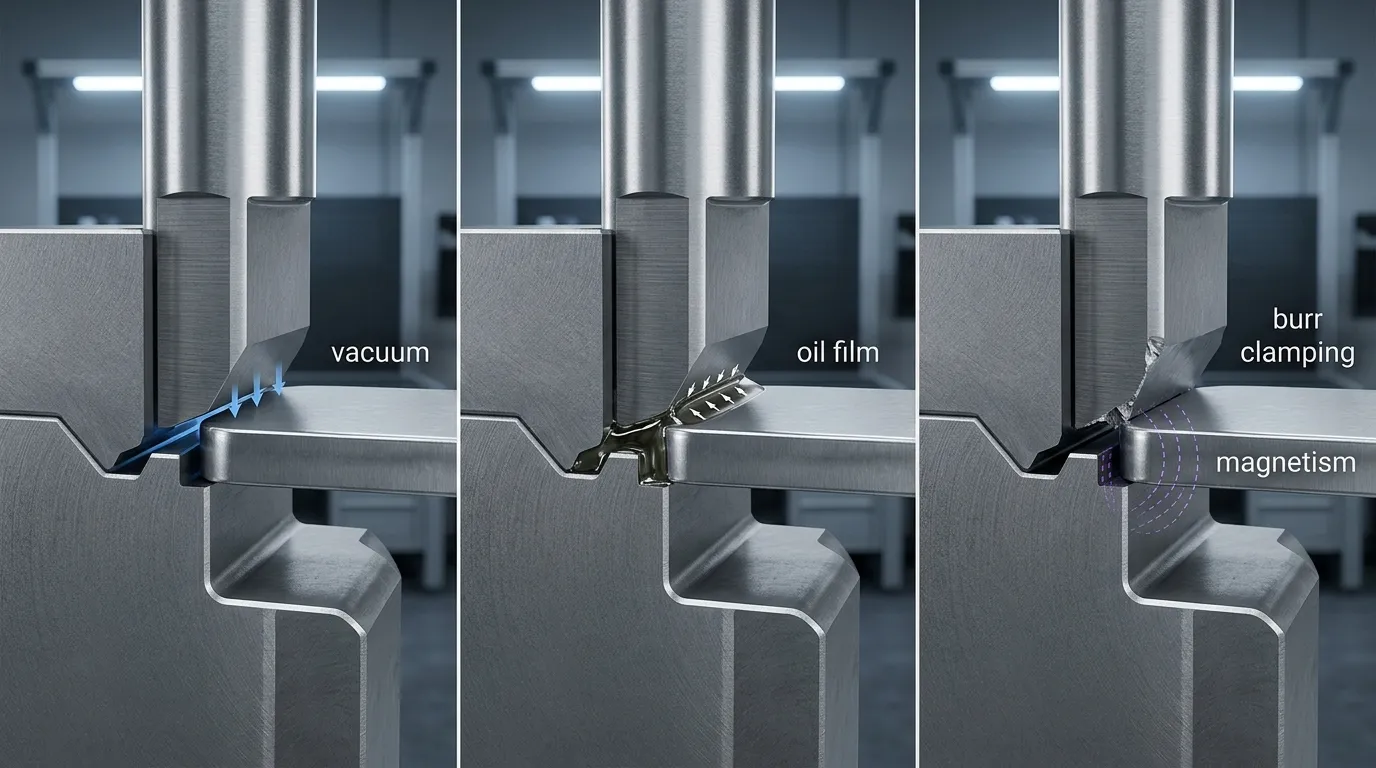
Adhesi Vakum dan Film Minyak
After the slug separates, a small sealed space may form between the punch face and the slug. As the punch retracts, pressure in that space can fall below the surrounding pressure. The resulting vacuum force helps keep the slug against the punch face.
Vacuum-related pulling may become more influential when:
- The slug has broad, flat contact with the punch face.
- The punch retracts quickly.
- Air cannot enter the space easily.
- The punch travels deeply into the die.
- The punch diameter creates a relatively large sealed area.
- Lubricant helps maintain the seal.
Lubricant can also create its own adhesive force. A thick oil film between the punch face and slug may resist separation, especially when the lubricant has high viscosity or is applied excessively.
That does not mean lubrication should simply be removed. Lubricant may be necessary for tool wear control, strip movement, and part quality. The correct response is to review the lubricant type, kuantitas, suhu, and application consistency through controlled trials.
Magnet Sisa dan Penjepitan Burr
A steel punch can retain magnetism after grinding, sharpening, or contact with magnetic workholding equipment. If the slug material is ferromagnetic, magnetic attraction may be enough to carry a small or light slug upward.
Residual magnetism is especially suspect when slug pulling begins immediately after:
- Punch sharpening.
- Surface grinding.
- Magnetic chuck use.
- Punch replacement.
- Maintenance involving magnetic tools.
Burr clamping is a different mechanism. During fracture, the slug edge may develop a burr that mechanically grips the punch cutting edge. Worn edges, mengelupas, unsuitable clearance, and changes in fracture geometry can increase this gripping action.
The distinction matters. Demagnetizing will not correct mechanical clamping, while sharpening alone will not remove residual magnetism.
Retensi Die yang Tidak Memadai atau Pelepasan Siput yang Salah
The die channel must perform two tasks that can conflict with each other. It must resist the slug’s upward return, but it must also allow the slug to travel downward without stacking or excessive compression.
Punch-to-die clearance affects:
- Fracture behavior.
- Slug size and deformation.
- Burr direction and size.
- Contact between the slug and die wall.
- Cutting and stripping forces.
- The slug’s ability to move through the die.
Excessively open clearance may reduce useful die-wall retention or create unstable slug behavior. Excessively tight clearance may increase cutting force, memakai, burr-related clamping, or slug compression.
Die land length, relief geometry, internal wear, deposits, and damaged transitions also affect the holding and release forces. Penelitian tentang Tekanan kontak die-to-slug shows that die geometry and radial contact influence slug-retaining friction. More compression is not automatically better; excessive plastic deformation may reduce the effective retaining stress or contribute to stacking.
There is therefore no universal clearance percentage that prevents slug pulling in every material, ketebalan, and punch geometry.
Diagnosis Penyebabnya Sebelum Memodifikasi Alat
A structured investigation is usually more effective than immediately adding an ejector, changing clearance, or modifying the die.
- Confirm that the slug follows the punch.
Observe the slug during retraction and determine whether it remains attached, releases near the stripper, or becomes loose only after leaving the die. - Identify what changed before the failure appeared.
Check for recent sharpening, a new material coil, a lubricant change, higher press speed, component replacement, die regrinding, or clearance adjustment. - Record where the slug releases.
A slug that stays attached throughout the upstroke may indicate a strong vacuum, oil adhesion, magnetism, or burr clamping. A slug that releases near the die entrance may indicate marginal retention. - Inspect the punch face and cutting edge.
Look for wear, mengelupas, built-up material, oil residue, burr marks, or circular witness marks from repeated contact. - Inspect the die channel.
Check the land, relief, wall condition, deposits, kerusakan, and evidence of slug stacking. - Check for residual magnetism.
Compare the punch’s attraction before and after demagnetizing when magnetic sticking is suspected. - Verify the actual clearance.
Do not rely only on the nominal drawing. Confirm punch size, Pembukaan, memakai, and clearance per side in the current tool condition. - Review punch penetration.
Too little penetration may fail to advance the slug into a retaining or relief region. More penetration, namun, may increase the volume change beneath the punch and strengthen vacuum during withdrawal. - Compare slow and production-speed behavior.
A setup that works during slow cycling may fail when withdrawal speed, pelumasan, getaran, and thermal conditions reach normal production levels. - Change one variable at a time.
If clearance, pelumasan, kecepatan, and penetration are changed together, the team cannot reliably identify which adjustment corrected or worsened the problem.
All inspection and testing should follow the plant’s approved press-safety and toolroom procedures.
Mencocokkan perbaikan dengan penyebab yang dikonfirmasi
Start with reversible maintenance and setup corrections. Move to process changes next. Punch-side or die-side modifications should follow only when the observed mechanism justifies them.
Pemeliharaan dan Koreksi Pengaturan
| Kondisi yang diamati | Periksa | Kemungkinan koreksi |
| Masalah dimulai setelah penggilingan | Sisa daya tarik magnetik | Demagnetisasi pukulan dan verifikasi hasilnya |
| Film oli terlihat antara pukulan dan siput | Jumlah pelumas dan viskositas | Memperbaiki aplikasi yang berlebihan atau tidak konsisten |
| Tanda gerinda atau tepi mencengkeram pukulan | Cutting-edge wear, mengelupas, pembersihan | Pulihkan tepi dan periksa kembali jarak bebas aktual |
| Endapan pada dinding punch atau die | Pengambilan atau kontaminasi material | Bersihkan permukaan yang terkena dan selidiki sumbernya |
| Tanda saksi tidak merata | Penyelarasan pukulan dan mati | Perbaiki perataan sebelum mengubah geometri |
| Masalah dimulai setelah penggantian | Dimensi dan penetrasi yang dipasang | Konfirmasikan komponen baru cocok dengan gambar dan pengaturan |
These checks are relatively low cost and can reveal whether the failure was introduced by maintenance or setup rather than the original die design.
Penyesuaian Proses dan Geometri
Clearance should be reviewed as part of the whole cutting condition, not changed in one direction by default. The correct value depends on the material, ketebalan, hole size, part-quality requirement, kondisi alat, and die geometry.
Punch penetration also requires careful evaluation. Increasing entry may help place the slug deeper into a retaining section, but it may also increase vacuum effects. Reducing entry may decrease vacuum volume while leaving the slug insufficiently controlled by the die.
Other controlled adjustments may include:
- Reviewing lubricant quantity and delivery position.
- Comparing lower and normal production speeds.
- Correcting inconsistent material feeding or strip support.
- Restoring the intended die land and relief condition.
- Confirming that the slug can move downward without obstruction.
After each change, check hole quality, burr condition, stripping behavior, tool marks, and scrap movement. A correction that stops slug pulling but creates excessive burrs or die-channel stacking is not a complete solution.
Modifikasi Perkakas Punch-Side dan Die-Side
Punch-side modifications act directly on the slug or the pressure beneath the punch:
- Pukulan berventilasi: Provides a path for pressure equalization and is most relevant when vacuum is the dominant mechanism.
- Mechanical slug ejector: Uses a spring-loaded or resilient element to push the slug away from the punch face.
- Compressed-air blow-off: Applies a timed downward force through or near the punch.
- Geometri geser: Reduces full-face contact or deforms the slug so it separates more easily from the punch.
Die-side modifications increase resistance to upward movement or improve controlled discharge:
- Slug-retention grooves or catcher features: Create local interference below the cutting edge.
- Controlled die-wall contact: Uses the die channel to generate sufficient retaining friction.
- Corrected land and relief geometry: Holds the slug where needed, then permits downward release.
- Repair or replacement: Restores worn or damaged internal geometry.
Each option has limitations. Small punches may not have enough internal space for a vent or ejector. Air passages can clog, consume compressed air, or weaken a slender punch. Ejector elements can fatigue. Shear geometry may create side loading or unacceptable slug deformation. Retention features must remain effective after sharpening and must not create slug stacking.
Penelitian tentang udara bertekanan tinggi untuk menghilangkan siput also shows why pneumatic approaches should be treated as application-specific tooling solutions rather than universal retrofits.
Bandingkan Metode Pencegahan Penarikan Siput berdasarkan Mekanisme dan Trade-Off
| Metode | Mekanisme yang paling pas | Keuntungan utama | Batasan utama | Apa yang harus diverifikasi |
| Demagnetisasi | Magnet sisa | Cepat dan invasif minimal | Tidak memperbaiki vakum atau duri clamping | Daya tarik magnetik berkurang dan menarik berhenti |
| Ulasan pelumas | Adhesi film minyak | Dapat memperbaiki masalah tanpa modifikasi alat | Pelumas yang terlalu sedikit dapat meningkatkan keausan | Tool wear, strip movement, and part quality remain acceptable |
| Restorasi tepi | Penjepitan duri atau ujung tombak yang aus | Mengembalikan kondisi fraktur yang dimaksudkan | Penajaman dapat mengubah entri atau meninggalkan magnet | Kondisi tepi, penetration, and magnetism |
| Koreksi izin | Retensi fraktur atau mati yang buruk | Mengatasi variabel pemotongan fundamental | Wrong adjustment can increase burrs, kekuatan, or wear | Hole quality, burr, mengupas, dan gerakan slug |
| Penyesuaian penetrasi | Siput tidak memasuki wilayah cetakan yang benar | Dapat meningkatkan posisi siput | Entri yang lebih besar dapat memperkuat vakum | Posisi siput dan perilaku kecepatan produksi |
| Pukulan berventilasi | Vakum | Langsung menyamakan tekanan | Bagian dapat menyumbat atau mengurangi kekuatan pukulan | Jalur udara tetap terbuka dan pukulan tetap sesuai secara struktural |
| Ejektor mekanis | Daya rekat wajah yang kuat | Menambahkan gaya pemisah positif | Membutuhkan ruang dan perawatan berkelanjutan | Ejector force, kelelahan, and timing |
| Udara terkompresi | Vakum atau adhesi persisten | Kuat, controllable separation | Needs air supply, timing, and clean passages | Air consumption, clogging, and reliable ejection |
| Geometri geser | Kontak wajah lebar atau adhesi | Mengganggu kontak tanpa mekanisme internal | Dapat membuat pemuatan samping atau deformasi siput | Pemuatan pukulan dan persyaratan suku cadang |
| Fitur retensi die | Ketahanan yang tidak mencukupi terhadap pembalikan siput | Menahan siput di bawah ujung tombak | Dapat mempengaruhi penajaman dan aliran skrap | Retensi tetap efektif tanpa penumpukan |
| Sensor pelindung mati | Siklus abnormal intermiten | Dapat menghentikan penekanan sebelum kerusakan berulang | Mendeteksi masalah tetapi tidak menghilangkan penyebabnya | Reliable detection under oil, getaran, and normal speed |
The best option is determined by the confirmed mechanism, available tool space, punch strength, material conditions, persyaratan pemeliharaan, and whether the method prevents, removes, or only detects the abnormal slug.
Verifikasi bahwa perbaikan berfungsi pada kecepatan produksi
A few successful slow strokes do not prove that the problem is resolved. Vakum, lubricant behavior, getaran, and scrap movement can change as the press reaches normal operating speed.
Use a controlled verification sequence:
- Confirm consistent slug release during reduced-speed observation.
- Increase to normal production speed according to approved procedures.
- Check that slugs travel through the intended die and scrap path.
- Inspect pierced holes and surrounding surfaces for new marks.
- Check that burr condition has not worsened.
- Confirm that stripping remains stable.
- Inspect the punch and die edges for unusual witness marks.
- Make sure slugs are not accumulating in the die channel.
- Observe the tool after it reaches normal operating temperature.
- Record any recurrence rather than judging the result from a few cycles.
The test record should include the material lot, lubricant condition, kecepatan tekan, changed variable, run duration, observations, and inspection results. This makes later recurrence easier to trace.
Informasi yang Harus Dikumpulkan Sebelum Meminta Modifikasi Pukulan atau Die
When maintenance and controlled process adjustments do not resolve slug pulling, a tooling supplier will need more than a damaged punch sample.
Siapkan:
- Part or strip drawing.
- Punch and die dimensions.
- Material grade and thickness.
- Hole or slug shape and size.
- Actual clearance per side.
- Punch penetration depth.
- Die land and relief dimensions.
- Press type and production speed.
- Lubricant type and application method.
- Sharpening and maintenance history.
- Photos of the punch face, cutting edge, die channel, slug, dan burr.
- Video showing when and where the slug releases.
- Frekuensi kegagalan.
- Recent process or tooling changes.
- Corrections already tested and their results.
- Required hole, burr, and surface-quality criteria.
Complete application data helps distinguish between a replacement component, a geometry correction, or a process problem that would not be solved by a new punch.
SunshinePro pin punch kustom page confirms drawing-based customization of punch dimensions, profil, bahan-bahan, dan perlakuan permukaan. It also lists CNC machining, EDM, penggilingan, dan perlakuan panas. These verified capabilities support component review, but they do not by themselves confirm availability of vented punches, sistem ejector, pneumatic passages, or slug-retention features.
Ketika penggantian atau tinjauan perkakas khusus dibenarkan
Replacement or custom tooling review becomes reasonable when:
- The punch or die is too worn or damaged for practical restoration.
- Actual geometry no longer matches the intended clearance or penetration.
- The die channel cannot provide reliable retention and discharge.
- Slug pulling returns after confirmed maintenance and process corrections.
- A different punch profile or component dimension is required.
- A proposed vent, pengusir, shear, or retention feature needs structural review.
Daftar SunshinePro meninju cetakan dan pin among its product categories and offers drawing-based custom punch components. For a technical review, provide the drawings, material information, tool dimensions, kecepatan tekan, lubricant conditions, and observed slug behavior through the Halaman kontak SunshinePro. The goal should be to review the component against the confirmed failure mechanism rather than requesting a generic anti-slug modification.
Bagikan:


Ditulis oleh Sunshine
di Sunshine, Kami adalah produsen dan pemasok profesional komponen cetakan presisi, menawarkan berbagai produk untuk aplikasi stamping dan cetakan injeksi. Fokus utama kami adalah mencetak cetakan, pin dan lengan ejector, serta tiang panduan dan bushing. Dengan pemesinan CNC canggih, kontrol kualitas ketat, dan kemampuan produksi yang kuat, kami memastikan keandalan, suku cadang presisi tinggi, bersama dengan komponen standar yang tersedia untuk pasokan global yang cepat dan efisien.
BERITA
DAPATKAN LAYANAN
Dengan suku cadang berkualitas untuk memenuhi setiap anggaran dan staf ramah yang terlatih untuk membuat kunjungan Anda menjadi informatif dan tanpa repot.
