



Pin Punch untuk Stamping Baja Tegangan Tinggi: Ketangguhan dan Keausan
Punch pins for high tensile steel stamping must resist two competing problems: progressive wear and sudden fracture. Choosing the hardest available material may slow edge wear, but it can also leave a slender or heavily loaded punch more vulnerable to chipping. Choosing a tougher material may reduce breakage while allowing faster abrasive wear.
The correct specification starts with the exact sheet grade and the observed failure mode. Punch material, perlakuan panas, geometri, pembersihan, penyelarasan, finishing permukaan, pelapisan, pelumasan, and stripping conditions must work as one system. Untuk informasi lebih luas tentang tipe die, bahan-bahan, and punch-to-die relationships, lihat Panduan Cetakan Meninju (disimpulkan).
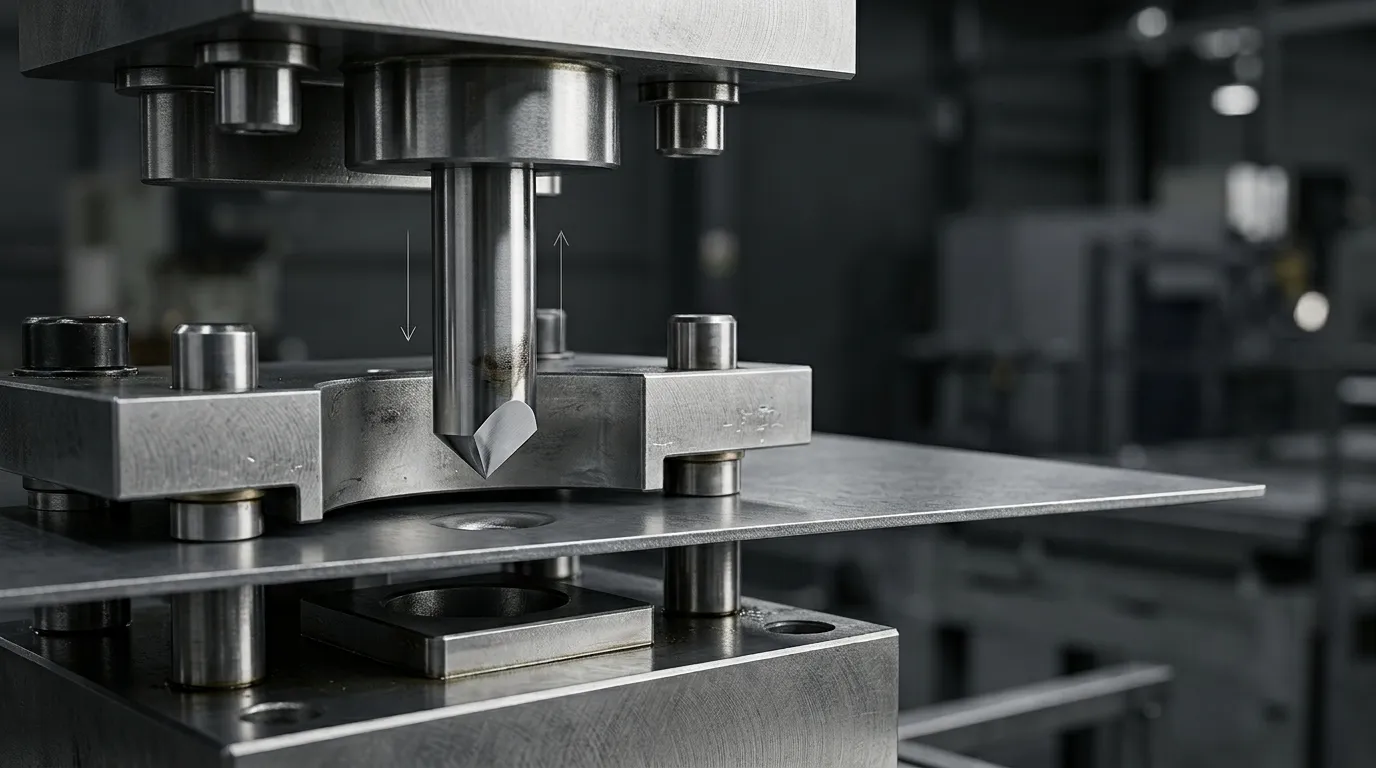
Mengapa Baja Tarik Tinggi Mengubah Persyaratan Punch-Pin
Higher-strength sheet places greater demands on the punch, Tombol, penari telanjang, sistem panduan, dan pers. The punch must penetrate the sheet without deforming, survive the sudden release of stored energy as the material fractures, and withdraw without excessive adhesion or side loading.
The workpiece description should include more than “high-tensile steel.” Important inputs include:
- Kelas baja yang tepat
- Hasil dan kekuatan tarik
- Ketebalan lembaran
- Pelapisan atau pelapisan permukaan
- Kondisi pelumasan
- Ukuran dan bentuk lubang
- Kualitas tepi yang dibutuhkan
- Tingkat produksi dan panjang berjalan
These factors influence cutting load, keausan abrasif, gesekan, menyebalkan, formasi burr, and stripping force. Two steels with similar tensile-strength ratings can behave differently because their microstructures and surface conditions are not identical.
High-Tensile Steel, AHSS, and UHSS Are Not Interchangeable Specifications
“High-tensile steel” is a broad commercial term. Advanced high-strength steel, or AHSS, includes several material families such as dual-phase, complex-phase, and martensitic steels. UHSS generally refers to the higher-strength portion of this wider group, although terminology can vary by supplier and industry.
The label alone is not enough to select a punch. A tooling supplier needs the complete grade designation, mechanical properties, ketebalan, dan kondisi permukaan. Technical overviews of Klasifikasi baja berkekuatan tinggi canggih also show why strength numbers should be considered alongside the steel’s metallurgical type.
Beban yang lebih tinggi dapat menghasilkan keausan dan patah tulang pada saat yang bersamaan
A punch used on higher-strength sheet may experience more than one failure mechanism.
A hard, wear-resistant edge can still chip if it receives uneven loading. A tougher punch may survive impact but lose dimensional accuracy through abrasive wear. Material pickup can increase friction during withdrawal, adding bending stress to a small-diameter punch.
This is why punch life cannot be predicted from hardness alone. Hardness and compressive strength help resist deformation and wear. Toughness and ductility help the tool tolerate impact, membengkokkan, stress concentrations, and crack propagation.
Diagnosis Mode Kegagalan Sebelum Mengganti Bahan Punch
Before upgrading the punch material, inspect the failed tool and the parts it produced. Look at the cutting edge, sayap, tubuh, kepala, bahan yang melekat, scoring direction, burr trend, and the location of any cracks.
The following table provides a practical starting point.
| Kondisi yang diamati | Mekanisme kemungkinan | Pemeriksaan pertama | Properti atau arah koreksi |
|---|---|---|---|
| Tepi membulat secara bertahap dan meningkatkan duri | Keausan abrasif | Sheet grade, pembersihan, kondisi permukaan, run length | Greater wear resistance, improved finish, revised clearance or coating |
| Bahan kerja yang melekat pada pukulan | Keausan perekat atau galling | Pelumasan, sheet coating, punch finish, withdrawal condition | Gesekan yang lebih rendah, better surface finish, suitable coating or process correction |
| Potongan-potongan kecil hilang dari ujung tombak | Chip tepi | Penyelarasan, pembersihan, geometri tepi, perlakuan panas | Greater toughness, lower stress concentration, dukungan yang ditingkatkan |
| Retak besar atau fraktur total | Retak atau kerusakan kotor | Beban samping, panjang tidak didukung, panduan, kekerasan, geometri punch | Ketahanan fraktur yang lebih besar ditambah koreksi sistem |
| Edge rolls, mushrooms, or changes shape | Deformasi plastik | Cutting load, kekerasan substrat, perlakuan panas, kekuatan tekan | Kekuatan tekan yang lebih besar atau perlakuan panas yang dikoreksi |
| Satu sisi aus atau terkelupas lebih cepat | Pemuatan tidak merata | Die-button position, pakaian panduan, pengalihan pers, konsentrisitas | Kembalikan keselarasan dan jarak bebas yang merata sebelum mengganti material |
Itu Diskusi Pedoman AHSS tentang perkakas dan keausan die separates abrasive wear, keausan perekat, mengelupas, retak, and plastic deformation because they do not have the same cause or corrective action.
Keausan Abrasif, Keausan Perekat, and Galling
Abrasive wear removes punch material progressively. Common signs include edge rounding, penilaian, kerugian dimensi, and a gradual increase in burr height. Hard phases in the workpiece, skala, surface contamination, and repeated contact can contribute to this type of deterioration.
Adhesive wear involves material transfer between the sheet and punch. The workpiece may stick to the punch surface, creating pickup, smearing, atau penilaian. Severe adhesion can develop into galling, where rough transferred material increases friction and damages both surfaces.
Before specifying a harder substrate, periksa:
- Permukaan akhir pukulan
- Jenis dan konsistensi pelumas
- Lapisan lembaran
- Jarak bebas pukulan hingga mati
- Arah penggilingan
- Kondisi pengupasan
- Kerusakan lapisan yang ada
A coating may reduce friction or pickup, but it cannot compensate for severe misalignment, unstable geometry, or an unsuitable base material.
Edge Chipping, Gross Cracking, and Plastic Deformation
Edge chipping is a localized fracture. It may result from inadequate toughness, excessive edge stress, pembersihan tidak merata, a sharp stress concentration, dukungan yang buruk, or an unsuitable heat-treatment condition.
Gross cracking affects a larger section of the punch and may lead to complete separation. Pemuatan samping, panjang berlebihan tanpa dukungan, ketidaksejajaran, poor transitions between sections, or an excessively brittle substrate can contribute. Broader fracture causes are covered in kerusakan pukulan pada cetakan stamping.
Plastic deformation is different. Instead of cracking, the punch permanently changes shape because the applied stress exceeds the material’s compressive capability. The edge may roll or mushroom. A tougher material is not necessarily the answer; the punch may need greater hardness, kekuatan tekan, improved heat treatment, or reduced loading.
Cocokkan Keluarga Bahan Pukulan dengan Risiko Dominan
Material selection should begin with the property that is missing, not with a familiar grade name. The practical question is whether the application primarily needs more wear resistance, ketangguhan, kekuatan tekan, galling resistance, or a balanced combination.
| Keluarga material | Arah pemilihan khas | Keuntungan utama | Batasan utama |
| Baja perkakas kerja dingin konvensional | Permintaan keausan sedang hingga tinggi dengan pemuatan yang stabil | Pemrosesan yang mapan dan ketahanan aus yang berguna | Beberapa nilai dapat terkelupas di bawah benturan parah atau pembengkokan |
| Baja berkecepatan tinggi | Combined hardness, ketahanan aus, and improved toughness | Performa seimbang untuk banyak aplikasi pukulan | Performa masih sangat bergantung pada perlakuan panas dan geometri |
| Baja perkakas metalurgi serbuk atau PM-HSS | Aplikasi yang menuntut dengan gabungan risiko keausan dan patah tulang | Distribusi karbida yang lebih seragam dan kombinasi properti yang lebih luas | Biaya material yang lebih tinggi harus dibenarkan oleh aplikasi |
| Karbida | Severe abrasive wear under rigid, well-aligned conditions | Ketahanan aus dan tekan yang tinggi | Lebih sensitif terhadap benturan, membengkokkan, dukungan yang buruk, dan ketidakselarasan |
No family is universally superior. A stable, well-supported application with gradual abrasive wear may justify a different material from a small punch that repeatedly chips under side load.
Baja Perkakas Konvensional dan Baja Berkecepatan Tinggi
Conventional cold-work tool steels can provide strong wear resistance, but their toughness varies widely. A D2- or SKD11-type material may be appropriate in a stable application where abrasive wear dominates, yet it may not be the best direction for a slender punch experiencing impact or uneven loading.
High-speed steels such as M2- or SKH51-type grades are commonly considered when the application needs a stronger balance of hardness, ketahanan aus, and toughness. This does not make HSS automatically better. Perlakuan panas, diameter punch, jari-jari transisi, panduan, and operating conditions can have more influence than the grade label alone.
SunshinePro mencantumkan SKH51, SKH9, and DC53 among its punch-pin material options. These are available choices, not universal recommendations for every AHSS or UHSS operation.
Baja Perkakas Metalurgi Serbuk untuk Tuntutan Keausan dan Fraktur Gabungan
Powder-metallurgy production can create a more uniform distribution of alloy carbides than conventional ingot processing. This may allow tool-steel grades to combine high wear resistance with better resistance to chipping or fatigue.
PM materials still have different priorities. Technical guidance may position one grade toward wear resistance and another toward toughness. Misalnya, PM-M4 is often discussed as a wear-focused option, while PM-3V is commonly considered where resistance to chipping and impact carries more weight. These are directional comparisons, not interchangeable specifications.
SunshinePro lists ASP materials among its available punch-pin options. The appropriate ASP grade and heat-treatment condition would still need to be selected from the actual workpiece, geometri, kondisi produksi, dan sejarah kegagalan.
Ketika Karbida Membantu—dan Ketika Menciptakan Risiko Baru
Carbide offers high abrasive-wear resistance and compressive strength. It can be useful when the die is rigid, the punch is well supported, alignment is controlled, and progressive wear is the main problem.
Its limitations become important in shock-loaded or unstable conditions. Carbide is less tolerant of bending, edge impact, ketidaksejajaran, and weak support than tougher tool-steel systems. A long, narrow carbide punch can fail quickly if the underlying geometry and guidance are not suitable.
Production volume alone is not enough to justify carbide. The decision should also consider:
- Diameter pukulan dan panjang yang tidak didukung
- Kondisi benturan dan snap-through
- Kekakuan
- Kondisi sistem panduan
- Geometri tepi
- Persyaratan penggilingan ulang
- Konsekuensi dari fraktur mendadak
Pemeriksaan Izin, Penyelarasan, and Geometry Before Blaming the Punch Material
A premium punch material will not correct an unstable die system. Izin, penyelarasan, panduan, kekakuan, geometri, and stripping conditions should be checked before a substrate change is approved.
Jarak bebas dan penyelarasan mengubah beban pada ujung tombak
Punch-to-die clearance affects cutting force, fracture development, formasi burr, beban tepi, and tool wear. The correct value depends on the exact sheet grade, ketebalan, edge-quality target, kondisi perkakas, and operation. A single clearance percentage should not be applied to all high-tensile steels.
Uneven clearance can be more damaging than an imperfect nominal value. If one side of the punch contacts earlier, that section receives concentrated load and may wear or chip first.
Penyebab yang mungkin meliputi:
- Tiang pemandu atau bushing yang aus
- Posisi tombol mati salah
- Gerakan pemegang pukulan
- Tekan atau mati-set defleksi
- Kesalahan perakitan
- Keausan kancing mati yang dilokalisasi
Itu Panduan Komponen Die Menjelaskan bagaimana pukulan, Tombol-tombol, penari telanjang, tiang panduan, and bushings interact within the wider die system.
Diameter, Panjang Tidak Didukung, Stripping, and Lubrication Affect Survival
Small-diameter punches are sensitive to bending because their cross-sectional area is limited. Risk increases when the unsupported length is excessive, guidance is weak, or material pickup creates lateral force during withdrawal.
Punch geometry should therefore be reviewed as carefully as the substrate. Important details include:
- Hubungan diameter-ke-panjang
- Desain kepala dan betis
- Jari-jari transisi
- Persiapan mutakhir
- Relief atau lancip
- Panduan di dekat ujung kerja
- Dukungan penari telanjang
Stripping can also become a major load event. Material adhered to the punch increases withdrawal force. If the stripper does not support the sheet evenly, the punch may bend as it retracts.
Lubrication and surface finish influence this relationship. They should be evaluated together with the workpiece coating and punch finish rather than treated as general maintenance details.
Treat Heat Treatment, Permukaan Akhir, and Coating as One System
A material grade does not arrive with fixed performance. Heat treatment establishes the final hardness, ketangguhan, kekuatan tekan, stress condition, dan stabilitas dimensi. Grinding and surface finishing then influence geometry, gesekan, and the quality of the cutting edge.
Coating is the final surface intervention, not a replacement for a correctly processed substrate.
Perlakuan Panas Menetapkan Sifat Pukulan Nyata
The same tool-steel grade can perform differently when its heat-treatment condition changes. Excessive hardness may improve wear resistance while reducing tolerance for impact or stress concentration. Insufficient hardness may allow deformation, edge rolling, or rapid wear.
A responsible specification should define:
- Kelas bahan
- Kondisi perlakuan panas yang diperlukan
- Kisaran kekerasan yang dapat diterima
- Dimensi kritis setelah perlakuan panas
- Kondisi permukaan
- Metode inspeksi
- Setiap persyaratan penggilingan pasca-perawatan
SunshinePro lists vacuum heat treatment and precision grinding among its punch-pin processes. The final treatment and inspection requirements should still be agreed for the specific material and drawing.
Pelapis dapat mengurangi kerusakan permukaan tetapi tidak dapat memperbaiki desain yang lemah
PVD coatings can modify friction, adhesive behavior, and wear at the punch surface. They may be useful where galling, pengambilan, or progressive surface wear dominates.
They cannot correct:
- Ketidaksejajaran
- Panjang yang berlebihan yang tidak didukung
- Transisi bagian yang lemah
- Ketangguhan substrat yang tidak memadai
- Deformasi plastik di bawah lapisan
- Izin yang salah
- Persiapan tepi yang buruk
SunshinePro lists TiN and TiCN as optional punch-pin coatings. Selecting between them requires application-specific review rather than a generic life comparison.
Coating thickness must also be included in dimensional planning. Regrinding may remove the coating from the working area, requiring a decision about recoating, dimensional restoration, atau pengganti.
Gunakan Proses Pemilihan Pukulan Pertama Mode Kegagalan
A practical selection process should follow this order:
- Identify the workpiece completely.
Record the grade, yield and tensile strength, ketebalan, surface coating, hardness data where available, and lubrication condition. - Document the punch and die geometry.
Include hole size, diameter punch, bentuk kepala, panjang keseluruhan, panjang tidak didukung, die-button opening, intended clearance, and stripper arrangement. - Klasifikasikan kegagalan.
Determine whether the main problem is abrasive wear, menyebalkan, mengelupas, retak, deformasi, or uneven loading. - Correct system problems first.
Check alignment, pakaian panduan, die-button condition, pembersihan, pengalihan pers, mengupas, dan pelumasan. - Choose the required property direction.
Decide whether the application needs more wear resistance, ketangguhan, kekuatan tekan, gesekan rendah, or a balanced combination. - Select the substrate and heat-treatment condition together.
Do not choose a grade without defining how it will be processed. - Add finish and coating only where they address the failure mechanism.
Surface treatment should support the substrate and process, not hide an unresolved design problem. - Validate under controlled production conditions.
Monitor burr growth, pengambilan material, perubahan dimensi, mengelupas, interval pemeliharaan, and the condition of the die button.
Consider three common patterns:
- A small punch with repeated edge chipping usually requires alignment and unsupported-length checks before simply increasing hardness.
- A punch with material pickup on coated sheet may need better lubrication, menyelesaikan, or coating rather than a tougher core material.
- A stable high-volume operation showing gradual edge rounding may justify greater abrasive-wear resistance once clearance and alignment are confirmed.
The best option is the one that controls the actual failure at an acceptable cost per accepted part, not necessarily the punch with the highest initial material cost or hardness.
Siapkan Data Aplikasi Sebelum Meminta Pin Punch Kustom
A drawing provides dimensions, but it may not explain why the existing punch is failing. A useful technical review should include workpiece data, tooling details, process conditions, bukti kegagalan, and acceptance requirements.
Data yang akan Dikirim dengan Gambar atau Sampel Pukulan Gagal
Menyediakan:
Informasi benda kerja
- Kelas baja yang tepat
- Hasil dan kekuatan tarik
- Ketebalan lembaran
- Lapisan permukaan
- Pelumas dan metode aplikasi
Informasi pukulan dan mati
- Diameter dan profil pukulan
- Panjang keseluruhan dan tidak didukung
- Geometri kepala dan betis
- Pembukaan tombol mati
- Izin yang dimaksudkan
- Pengaturan penari telanjang dan panduan
- Bahan dan kekerasan pukulan yang ada
- Pelapisan dan permukaan akhir saat ini
Informasi produksi
- Jenis pers dan kondisi pengoperasian yang relevan
- Hit per menit
- Pukulan per lari
- Volume produksi yang diharapkan
- Sejarah penggilingan ulang
- Interval pemeliharaan yang direncanakan
Bukti kegagalan
- Foto yang jelas
- Lokasi retak atau chip
- Pengambilan atau penilaian material
- Tren duri
- Kehilangan dimensi
- Frekuensi kegagalan
- Apakah kerusakan terjadi selama penetrasi atau penarikan
SunshinePro states that punch diameter, panjang, bentuk kepala, material, and coating can be customized. Nya halaman produk punch-pin also lists SKH51, SKH9, DC53, ASP, karbida, penggilingan presisi, perlakuan panas vakum, TiN, and TiCN among available options.
Dokumentasi dan Validasi untuk Dikonfirmasi Sebelum Produksi
Sebelum menyetujui produksi, define which records and acceptance criteria are required. These may include:
- Identitas material atau sertifikat
- Kisaran kekerasan yang disepakati
- Inspeksi dimensi kritis
- Persyaratan permukaan akhir
- Jenis dan ketebalan lapisan
- Dimensi setelah lapisan
- Revisi gambar
- Proses persetujuan sampel
- Batas kualitas gerinda dan tepi
- Ekspektasi penggilingan ulang dan pelapisan ulang
SunshinePro’s product page lists dimensional capability up to ±0.002 mm and a hardness range of HRC 58–68. These should be treated as listed capability ranges, not universal specifications. Achievable tolerances and hardness depend on the selected material, geometri, perlakuan panas, pelapisan, gambar, and inspection agreement.
For an application review, send the drawing together with the sheet specification, kondisi operasi, and failure evidence through the Halaman kontak SunshinePro. This gives the supplier enough context to evaluate the punch material, geometri, perlakuan panas, menyelesaikan, and coating as one system rather than recommending a grade from the workpiece name alone.
Bagikan:


Ditulis oleh Sunshine
di Sunshine, Kami adalah produsen dan pemasok profesional komponen cetakan presisi, menawarkan berbagai produk untuk aplikasi stamping dan cetakan injeksi. Fokus utama kami adalah mencetak cetakan, pin dan lengan ejector, serta tiang panduan dan bushing. Dengan pemesinan CNC canggih, kontrol kualitas ketat, dan kemampuan produksi yang kuat, kami memastikan keandalan, suku cadang presisi tinggi, bersama dengan komponen standar yang tersedia untuk pasokan global yang cepat dan efisien.
BERITA
DAPATKAN LAYANAN
Dengan suku cadang berkualitas untuk memenuhi setiap anggaran dan staf ramah yang terlatih untuk membuat kunjungan Anda menjadi informatif dan tanpa repot.
