



Pemilihan Bahan Pin Pemosisian Cetakan dan Kekerasan
Mold positioning pin material and hardness should be selected as a complete specification, not as a steel name followed by the highest available HRC value. The correct choice depends on contact frequency, pemuatan samping, risiko dampak, korosi, pelumasan, diameter pin, finishing permukaan, and the material of the mating bushing.
Hardness improves resistance to indentation and wear, but excessive hardness or an unsuitable heat-treatment condition can reduce toughness and increase the risk of chipping or cracking. For wider context on alignment, cocok, pelumasan, and system wear, lihat pin cetakan dan bushing (disimpulkan). This guide focuses specifically on selecting and purchasing the pin’s material and hardness condition.
Pertama-tama Konfirmasikan Peran Pemosisian Pin
Manufacturers do not always use positioning pin terminology consistently. A positioning pin may also be described as a locating pin or centring pin, while some suppliers use guide pin or leader pin for a related component.
| Istilah komponen | Peran khas | Implikasi pemilihan material |
|---|---|---|
| Pin pemosisian atau lokasi | Menetapkan lokasi akhir yang dapat diulang antara komponen cetakan | Akurasi, keausan kontak, dampak, and mating-bushing properties are critical |
| Pin panduan atau pin pemimpin | Memandu pergerakan cetakan pada jarak keterlibatan yang lebih jauh | Kelurusan, sliding wear, pelumasan, and bushing engagement become more prominent |
| Pin dowel umum | Menetapkan lokasi komponen tetap dalam rakitan | Mungkin tidak mengalami kondisi geser atau benturan berulang yang sama |
| Ejector, core, or punch pin | Performs ejection, membentuk, pemotongan, or cavity-related work | Membutuhkan proses pemilihan bahan yang berbeda |
A component can perform both guiding and final positioning functions, but the designer should confirm its actual loading before specifying the steel. A long guide pin exposed to sliding friction may need different properties from a short locating pin that receives repeated impact during mold closure.
For a broader explanation of guiding components, use the dedicated guide to pin panduan cetakan. The material decisions below assume a pin used for repeatable mold positioning through engagement with a matching hole, sisipkan, or bushing.
Start With the Operating Conditions, Bukan kelas baja
Before comparing materials, define how the pin will operate. A supplier cannot reliably select a material from diameter and length alone.
Review these conditions first:
- Contact frequency and production demand: Repeated engagement increases accumulated wear, even when each individual cycle produces only moderate contact stress.
- Benturan dan pemuatan samping: Ketidaksejajaran, heavy mold sections, or abrupt engagement may require more core toughness than a lightly loaded precision locator.
- Pin diameter and section size: A steel that hardens effectively in a small pin may not produce the same through-section properties in a larger component.
- Required repeatability: Higher positioning accuracy increases the importance of dimensional stability, kebulatan, menyelesaikan, and controlled wear.
- Mating-bushing design: The pin and bushing should be selected as a material pair rather than as isolated parts.
- Pelumasan: Limited lubrication increases friction and the risk of adhesive wear, menyebalkan, or seizure.
- Kontaminasi: debu, metal particles, and molding residue can create abrasive wear.
- Corrosive exposure: Kelembapan, kondensasi, washdown, or chemical exposure may justify hardened stainless steel or a qualified protective treatment.
- Suhu: Elevated operating temperatures can affect hardness retention, lubricant performance, and coating suitability.
- Standard or custom sourcing: A catalog component may be adequate for common conditions, while unusual loading, ukuran, or documentation requirements may require a drawing-defined part.
Material selection cannot correct poor alignment, ruang yang tidak sesuai, or an unstable layout. Those issues should be resolved separately before increasing pin hardness.
Bandingkan Strategi Material Utama
The useful comparison is not simply “steel versus stainless steel.” Buyers should compare material families together with their final heat-treatment condition.
| Strategi material | Keuntungan utama | Batasan utama | Logika seleksi khas |
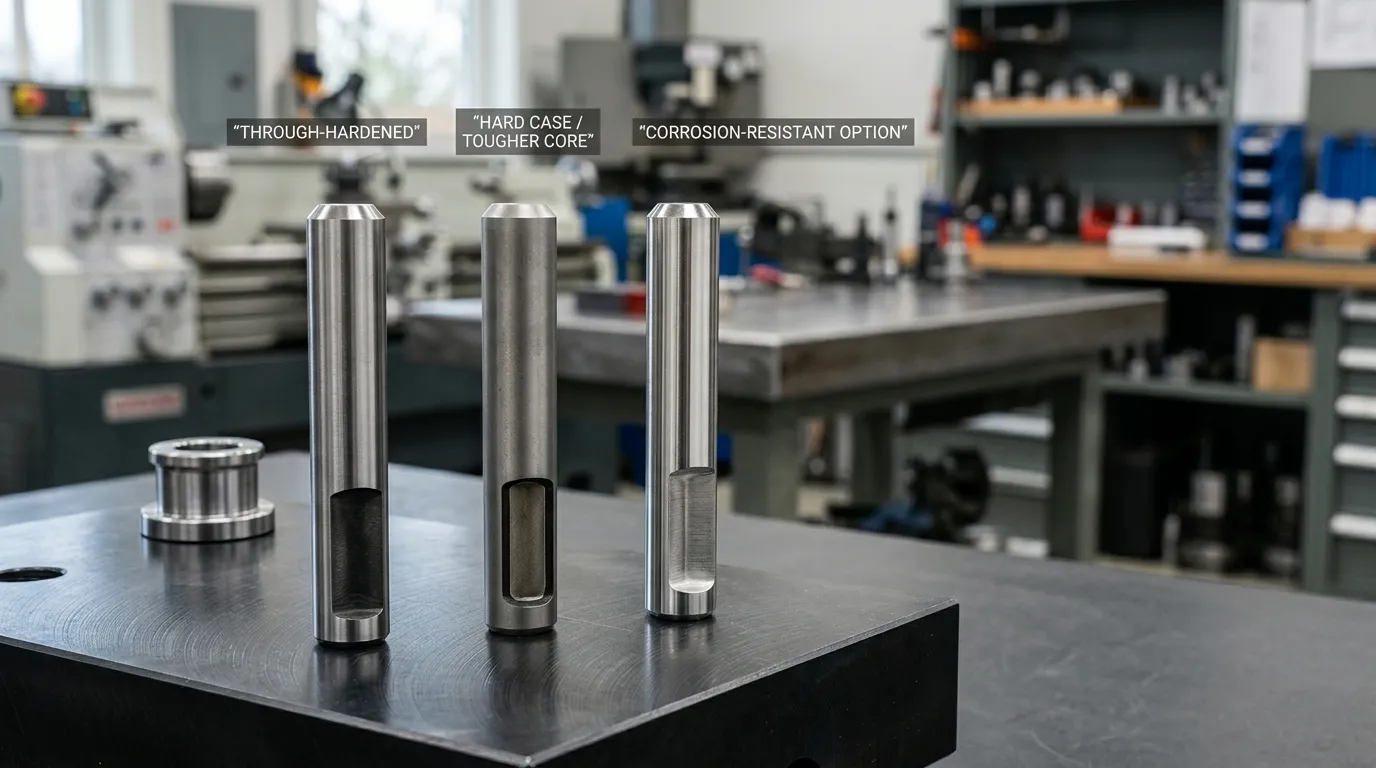
| Baja bantalan yang dikeraskan | Kekerasan tinggi melalui sebagian besar bagian dan potensi keausan yang kuat | May be less forgiving under impact or severe misalignment; corrosion protection may be needed | Repeated, controlled contact with good alignment and lubrication |
| Baja paduan pengerasan kasus | Permukaan tahan aus yang keras dengan inti pendukung yang lebih tangguh | Kedalaman Kasus, distorsi, and final grinding must be controlled | Repeated contact combined with shock, pemuatan samping, or impact risk |
| Baja perkakas yang dikeraskan | Ketahanan aus yang baik dan stabilitas dimensi potensial saat diproses dengan benar | Performa bervariasi secara signifikan berdasarkan kelas dan perlakuan panas | Geometri khusus atau kondisi keausan yang menuntut yang membutuhkan solusi baja perkakas yang ditentukan |
| Baja tahan karat yang dikeraskan | Ketahanan korosi yang lebih baik daripada baja karbon atau paduan yang dikeraskan konvensional | Kekerasan yang dapat dicapai, galling behavior, ketangguhan, and cost must be assessed | Humid, washed, condensed, or corrosion-prone environments |
Baja Bantalan Pengerasan Melalui
Through-hardening bearing steels can provide high hardness, kekuatan, and wear resistance across a meaningful portion of the pin section. Ovako describes 100Cr6 as a through-hardening bearing steel intended for applications requiring high hardness and high-cycle fatigue performance.
This strategy can suit a well-aligned positioning system with repeated contact and controlled lubrication. Namun, the grade name alone does not define the finished pin. The drawing still needs a final hardness range, kondisi perlakuan panas, dimensional requirements, dan metode inspeksi.
Regional designations such as SUJ2, GCr15, 100Cr6, and AISI 52100 may be treated as related bearing-steel families in commercial discussions, but they should not be substituted automatically. The governing material standard, kimia, cleanliness requirements, and approved heat-treatment condition should be confirmed.
Baja Paduan Pengerasan Kasus
Case-hardening steels are selected when the designer wants a hard contact surface supported by a tougher core. During carburizing, carbon is introduced into the surface before hardening, creating a wear-resistant case while retaining a different core condition.
Deskripsi teknis Bodycote tentang pengerasan kasus dan karburasi explains how this approach can combine surface hardness with core toughness. That balance is useful when a positioning pin experiences repeated engagement, dampak, atau beban samping.
A case-hardened specification should not stop at surface HRC. It may also need:
- Persyaratan kekerasan inti
- Kedalaman casing efektif
- Lokasi pengujian
- Tunjangan penggilingan pasca-perawatan
- Kelurusan dan diameter setelah finishing akhir
A very hard but shallow case may wear through prematurely. A deep case may be unnecessary or may complicate processing. The required depth should therefore be based on load, expected wear, geometri pin, and the chosen steel.
Baja Perkakas yang Dikeraskan dan Opsi Stainless
Hardened tool steels can be appropriate where wear resistance and dimensional control are important, but their performance depends heavily on the exact grade, kekerasan, kondisi tempering, and section size. “Tool steel” is not a complete purchase specification.
Hardened stainless steel is more relevant when corrosion exposure could damage a conventional hardened steel pin. A stainless option should still be evaluated for:
- Kekerasan yang dapat dicapai
- Kekuatan inti
- Kecenderungan galing
- Permukaan akhir
- Bahan kawin-bushing
- Tingkat keparahan lingkungan
A stainless pin with inadequate hardness may resist rust but wear too quickly. A highly hardened stainless pin may still gall against an unsuitable mating material when lubrication is poor.
SunshinePro lists SUJ2, GCr15, SKD11, and alloy steel on its Menemukan Bushing Panduan Pin page. Those are stated specifications for that bushing product and should not be interpreted as universal material options for every positioning pin.
Choose the Hardness Architecture, Not Just the Highest HRC
Two pins with the same measured surface hardness can behave differently because their hardness profiles and core conditions are different.
A through-hardened pin aims to develop hardness across the section, subject to the steel’s hardenability and the pin diameter. A case-hardened pin concentrates high hardness near the surface while maintaining a different core condition. Nitriding creates a hard surface layer through nitrogen diffusion and is sometimes chosen where wear, scuffing, perlawanan yang sangat menyakitkan, or lower process distortion is important.
Bodycote mencatat bahwa nitridasi gas can improve resistance to wear, scuffing, menyebalkan, and seizure. Its suitability still depends on the base steel and the required layer characteristics.
| Faktor seleksi | Melalui pengerasan | Pengerasan kasus | Nitridasi |
| Distribusi kekerasan | Meluas ke sebagian besar bagian | Permukaan keras di atas inti yang berbeda | Lapisan difusi yang mengeras di dekat permukaan |
| Potensi inti tangguh | Tergantung pada tingkat dan kekerasan akhir | Keunggulan desain pusat | Bergantung terutama pada bahan dasar yang telah dirawat sebelumnya |
| Persyaratan kedalaman casing | Biasanya tidak berlaku dengan cara yang sama | Seringkali penting | Mungkin diperlukan ketika kedalaman lapisan memengaruhi kinerja |
| Kontrol distorsi | Depends on grade, memadamkan, dan geometri | Membutuhkan tunjangan untuk karburasi dan pendinginan | Sering dipilih di mana distorsi yang lebih rendah berharga |
| Penggunaan terbaik | Kontak keausan tinggi yang terkontrol | Keausan dikombinasikan dengan guncangan atau benturan | Kontrol keausan permukaan atau galling pada baja dasar yang sesuai |
No process is universally superior. Geometri, pemuatan, distortion tolerance, final grinding, bahan kawin, and supplier capability all affect the decision.
kekerasan permukaan, Core Hardness, and Effective Case Depth
A complete specification may need three separate properties:
- Kekerasan permukaan: The hardness at or near the working surface. It strongly influences resistance to indentation and contact wear.
- Kekerasan inti: The hardness beneath the treated layer. It affects support, kekuatan, dan ketangguhan.
- Kedalaman casing efektif: The depth at which the material still meets a defined hardness criterion.
These values answer different questions. Surface hardness indicates how the contact area resists wear. Core hardness indicates whether the pin can support the surface under load. Effective case depth indicates how much usable hardened material exists before wear reaches a softer region.
For a through-hardened pin, a surface measurement may still be insufficient if section hardness is important. For a carburized pin, surface HRC without case-depth evidence does not fully describe the treated condition.
Tentukan kekerasan sehingga pemasok dapat memverifikasinya
A requirement such as “hardened to HRC 60” leaves several questions unanswered:
- Is 60 a target, minimum, or nominal value?
- What range is acceptable?
- Where should the test be taken?
- Does it apply to the surface, core, atau keduanya?
- Which test method should be used?
- Is case depth required?
- Is the result measured directly or converted from another scale?
A stronger drawing or RFQ requirement should identify:
- Kelas material dan standar yang mengatur
- Rute perlakuan panas
- Kisaran kekerasan yang dapat diterima
- Skala kekerasan
- Lokasi pengujian
- Penerapan permukaan atau inti
- Kedalaman casing yang efektif jika diperlukan
- Laporan inspeksi atau pengujian yang diperlukan
For hardened steels, Rockwell C is commonly used. ISO 6508-1:2023 defines the Rockwell hardness-test method, sementara ISO 6508-2:2023 addresses verification and calibration of Rockwell testing equipment and indenters.
Vickers testing may be more useful for localized measurements, thin treated zones, or a hardness profile across a section. The relevant method is defined in ISO 6507-1:2023.
Hardness conversions should be handled cautiously. ISO 18265 provides conversion principles, but a converted value is not automatically equivalent to a direct measurement under the required method. Jenis material, treatment condition, and measurement range can affect the relationship.
An incomplete requirement might state:
Hardened alloy steel, HRC 60.
A more usable requirement would define the material standard, pengobatan, acceptable HRC range, lokasi pengukuran, core condition, case depth if applicable, and reporting expectations. The exact values must come from the application rather than a generic template.
Cocokkan pin dan bushing sebagai sistem keausan
The positioning pin and its mating bushing form one contact system. Selecting each component independently can create avoidable wear or seizure.
A common design approach is to make the replaceable bushing the preferred wear component. That may involve selecting a pin that is harder than the bushing, but there is no universal hardness difference that suits every material pair and load condition.
Check the following together:
- Bahan pin dan kekerasan
- Bahan dan kekerasan bushing
- Permukaan akhir pada kedua komponen
- Durasi pertunangan
- Jarak bebas dan penyelarasan
- Metode pelumasan
- Paparan kontaminasi
- Risiko korosi
- Ketebalan lapisan atau perawatan
- Strategi penggantian
Two hard surfaces can still gall if their material pairing, menyelesaikan, or lubrication is unsuitable. A rough or misaligned bushing can also damage a correctly hardened pin. Coatings and diffusion treatments may alter final dimensions, so diameter and fit should be verified after all relevant processing is complete.
SunshinePro’s locating-pin guide-bushing page states HRC 58–62, a precision-ground finish, and standard or custom sizes for that specific product. Those details may help when evaluating a matching bushing, but the final pin-and-bushing combination still needs project-specific review.
Pilih berdasarkan Risiko Aplikasi
The table below provides selection directions rather than fixed material prescriptions.
| Kondisi operasi | Bahan awal atau arah perawatan | Pemeriksaan utama |
| Kontak siklus tinggi dengan penyelarasan dan pelumasan yang baik | Baja bantalan yang dikeraskan atau strategi baja kekerasan tinggi lainnya | Section hardness, menyelesaikan, bushing pairing, stabilitas dimensi |
| Benturan berulang atau pemuatan samping | Baja paduan pengerasan kasus dengan casing keras dan inti terkontrol | Core toughness, kedalaman kotak, distorsi, final grinding |
| Humid, condensed, or frequently cleaned environment | Baja tahan karat yang dikeraskan atau strategi perlindungan korosi yang memenuhi syarat | Kekerasan yang dapat dicapai, menyebalkan, paparan kimia, bahan kawin |
| Pelumasan terbatas | Suitable material pair, fine finish, and possible nitriding or other qualified surface treatment | Membelokkan, kejang, treatment compatibility, dimensi akhir |
| Kontaminasi abrasif | Ketahanan aus permukaan yang tinggi ditambah kontrol kontaminasi | Selesai, sealing or cleaning strategy, kedalaman kotak, bushing replacement |
| Diameter pin besar | Baja dengan kemampuan pengerasan yang memadai atau strategi pengerasan kasus | Through-section properties, core condition, heat-treatment uniformity |
| Kontrol dimensi yang ketat setelah perlakuan panas | Bahan dan proses dipilih untuk penggilingan akhir yang stabil | Grinding allowance, kelurusan, kebulatan, inspection after treatment |
These directions should be confirmed against the actual pin geometry, muatan, konstruksi cetakan, and supplier process. Material selection should reduce risk, not replace engineering validation.
Letakkan persyaratan lengkap pada gambar atau RFQ
A useful RFQ gives the supplier enough information to evaluate material availability, perlakuan panas, inspeksi, dan kemampuan manufaktur.
Termasuk:
- Fungsi bagian dan revisi gambar
- Diameter pin, panjang, geometri, and engagement area
- Kelas material yang tepat dan standar yang mengatur
- Nilai pengganti yang disetujui atau dilarang
- Rute perlakuan panas dan kondisi akhir
- Kisaran dan skala kekerasan permukaan
- Persyaratan kekerasan inti jika perlu
- Kedalaman kasus yang efektif jika perlu
- Lokasi dan metode uji kekerasan
- Permukaan akhir
- Toleransi diameter
- Persyaratan kelurusan dan kebulatan
- Pelapisan atau perawatan permukaan
- Kelonggaran dimensi untuk ketebalan lapisan
- Bahan dan kekerasan bushing kawin
- Sertifikat material yang diperlukan
- Catatan atau sertifikat perlakuan panas
- Laporan uji kekerasan
- Laporan kedalaman kasus jika berlaku
- Laporan inspeksi dimensi akhir
- Ketertelusuran dan ekspektasi pengambilan sampel
Standard catalog components may already have fixed material and hardness conditions. A custom pin needs clearer drawing control because the buyer is defining the final properties. The guide to Bagian standar cetakan provides additional context on deciding between standard and customized mold components.
Bendera Merah Pemasok
Review the quotation carefully when it contains any of these problems:
- "Baja yang dikeraskan" tanpa kelas atau standar
- Satu angka kekerasan tanpa skala atau rentang
- Tidak ada kondisi perlakuan panas
- Kekerasan permukaan disajikan sebagai bukti kekerasan inti
- Tidak ada persyaratan kedalaman casing untuk desain yang diperkeras
- Penggantian kelas informal tanpa persetujuan
- Nilai kekerasan yang dikonversi digunakan sebagai satu-satunya bukti
- Tidak ada lokasi pengujian yang ditentukan
- Lapisan ditentukan tanpa verifikasi ukuran akhir
- Service-life claims without load, cocok, pelumasan, and environmental conditions
A lower-cost quotation is not comparable if it omits material traceability, treatment details, or inspection requirements included in another supplier’s offer.
Konteks SunshinePro untuk Persyaratan Standar dan Kustom
SunshinePro’s website lists guide pins and bushings, Tiang panduan dan bushing, Komponen cetakan standar, and custom mold accessories. It also states that non-standard accessories can be produced from customer drawings or samples and that material-selection support is available.
Its Locating Pin Guide Bushing page lists SUJ2, GCr15, SKD11, baja paduan, HRC 58–62, a precision-ground finish, and standard or custom sizes. These are product-specific bushing details. They should not be applied automatically to every positioning-pin design or treated as proof that every material, pengobatan, or inspection method is available for every custom part.
A technical enquiry should therefore include the complete drawing and specification rather than only a requested diameter and hardness.
Daftar Periksa Pemilihan Material dan Kekerasan
Before approving a mold positioning pin specification, confirm that you have:
- Identified whether the component performs final positioning, general guidance, atau keduanya.
- Defined contact frequency, dampak, pemuatan samping, pelumasan, Kontaminasi, and corrosion exposure.
- Reviewed the mating-bushing material, kekerasan, menyelesaikan, dan strategi penggantian.
- Selected a material family based on the operating risks.
- Chosen through hardening, case hardening, or another qualified treatment route.
- Defined surface hardness and core requirements separately where needed.
- Added effective case depth for a case-hardened or nitrided design when relevant.
- Specified the hardness scale, jangkauan, metode pengujian, dan lokasi pengujian.
- Controlled final finish, diameter, kelurusan, kebulatan, and coating allowance.
- Requested the material, perlakuan panas, kekerasan, case-depth, and dimensional records appropriate to the project.
Once these requirements are defined, submit the drawing and technical conditions through SunshinePro’s Halaman kontak for feasibility review or a quotation. The enquiry should make clear which requirements are mandatory and where qualified alternatives may be considered.
Bagikan:


Ditulis oleh Sunshine
di Sunshine, Kami adalah produsen dan pemasok profesional komponen cetakan presisi, menawarkan berbagai produk untuk aplikasi stamping dan cetakan injeksi. Fokus utama kami adalah mencetak cetakan, pin dan lengan ejector, serta tiang panduan dan bushing. Dengan pemesinan CNC canggih, kontrol kualitas ketat, dan kemampuan produksi yang kuat, kami memastikan keandalan, suku cadang presisi tinggi, bersama dengan komponen standar yang tersedia untuk pasokan global yang cepat dan efisien.
BERITA
DAPATKAN LAYANAN
Dengan suku cadang berkualitas untuk memenuhi setiap anggaran dan staf ramah yang terlatih untuk membuat kunjungan Anda menjadi informatif dan tanpa repot.
