



Praktik Terbaik Penyimpanan Perkakas Tablet untuk Pencegahan Kerusakan
Tablet punches and dies should not move directly from cleaning into an unmarked drawer or shared container. A controlled storage process should include complete cleaning and drying, condition inspection, suitable corrosion protection, individual separation, clear identification, environmental monitoring, and a release check before reuse.
This guide focuses specifically on storing upper punches, lower punches, and dies. Readers who need broader context on tooling categories can refer to Jenis perkakas press tablet.
Effective tablet tooling storage must control four risks:
- Kontak fisik dan kerusakan penanganan
- Korosi, kelembapan, and condensation
- Produk, cleaner, or lubricant contamination
- Identifikasi perangkat dan kesalahan status
A cabinet can organize tooling, but it cannot correct incomplete drying, unidentified damage, an incompatible protectant, or poor handling.
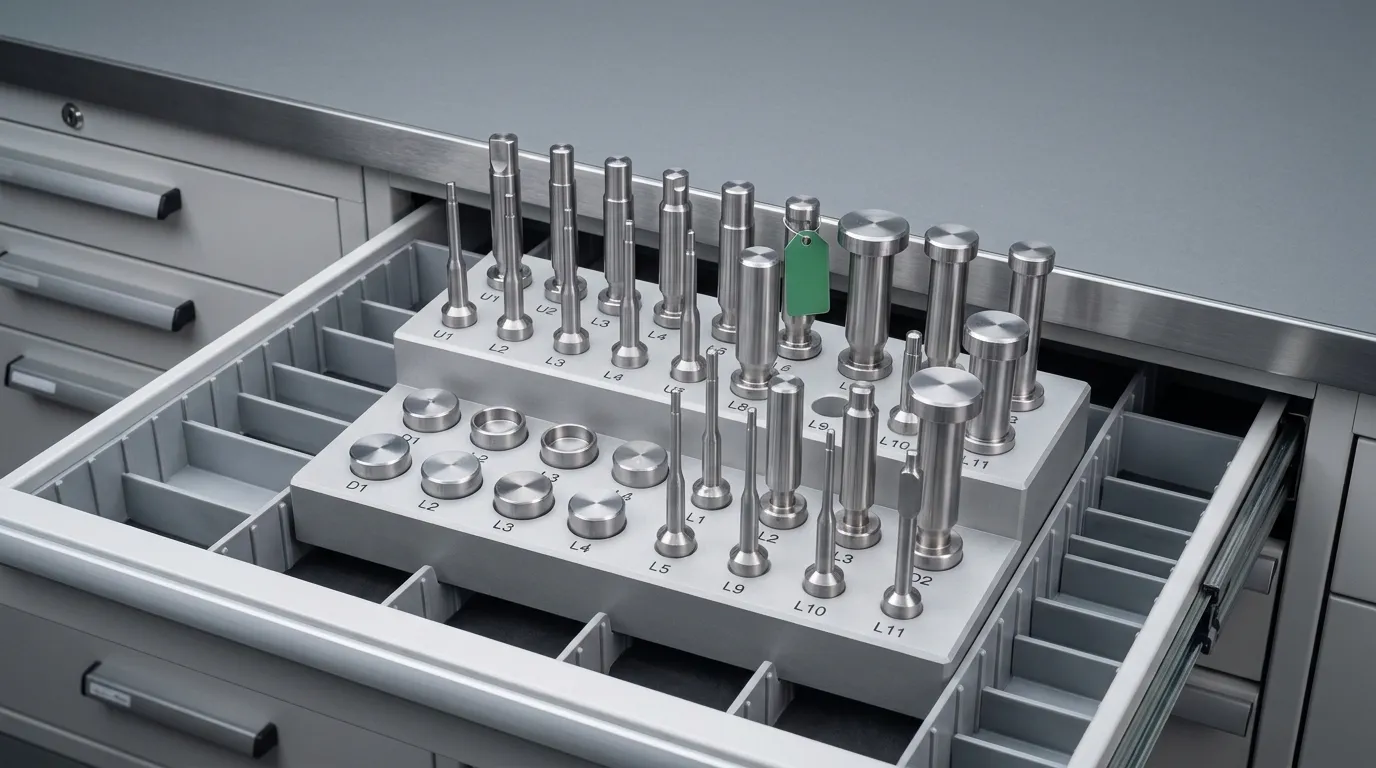
Mulailah dengan proses pra-penyimpanan yang terkontrol
Storage begins when the tooling leaves the tablet press, not when the storage container is closed.
Use a defined sequence:
- Move the tooling in a protected tray or case.
- Clean it using the facility’s approved procedure.
- Dry every surface completely.
- Inspect the full punch-and-die set.
- Record its condition and completeness.
- Assign a released, restricted, or quarantined status.
- Apply an approved storage protectant when required.
- Place each component in its designated storage position.
The procedure should identify who performs each step, which materials are approved, what records are required, and who can release the tooling for future use. For pharmaceutical operations subject to U.S. requirements, 21 CFR 211.67 requires written procedures for equipment cleaning and maintenance, including responsibilities, schedules, methods, bahan-bahan, inspeksi, and protection before use.
Bersihkan dan keringkan setiap permukaan perkakas
Remove tablet residue, cleaning-agent residue, old lubricant, and visible contamination before storage. Pay particular attention to:
- Cangkir dan ujung pukulan
- Fitur timbul atau terukir
- Tombol pukulan dan area tersembunyi
- Lubang dan tepi mati
- Area di mana air dapat tertinggal setelah dicuci
A tool that appears dry externally may still retain moisture in a cup, membosankan, jalan kunci, or recessed identification mark. Protective oil or grease should never be applied over retained water because the coating may trap moisture against the metal surface.
Itu Panduan validasi pembersihan Organisasi Kesehatan Dunia states that cleaned equipment should be stored dry and that storage periods and conditions before reuse should be addressed in the validated process.
The actual cleaner, metode pengeringan, and acceptance criteria should come from the facility’s approved procedure and the tooling material or coating supplier. One process should not be assumed suitable for every tool steel or surface treatment.
Periksa set dan tetapkan statusnya
Inspection should occur before a heavy protectant is applied because oil or grease may make small surface defects harder to see.
Periksa:
- Korosi atau perubahan warna
- Keripik, dents, goresan, or impact marks
- Damaged punch tips, cangkir, or embossing
- Kerusakan lapisan atau pengelupasan
- Gerinda di sekitar tepi die
- Tanda yang tidak biasa di dalam lubang die
- Identifikasi hilang atau tidak dapat dibaca
- Pukulan atau mati yang hilang
- Bukti penanganan yang salah
Reconcile the number of upper punches, lower punches, and dies against the set record. An incomplete or unidentified set should not enter normal released storage.
Tooling with visible damage, uncertain identity, incomplete cleaning records, or unknown protectant status should be segregated for further assessment.
Mencegah Kontak dan Penanganan Kerusakan
Metal-to-metal contact is one of the most preventable storage risks. Punches can be damaged when they strike one another inside loose bins, shift in an oversized tray, or rest directly on precision surfaces.
The storage system should prevent:
- Kontak pukulan ke pukulan
- Kontak pukulan untuk mati
- Dampak mati untuk mati
- Berat bertumpu pada ujung atau cangkir pukulan
- Gerakan saat laci atau baki dibuka
- Komponen longgar bergulir selama transportasi
Precision features requiring particular protection include punch tips, cangkir, embossing, kepala, barrels, keys, die edges, and die bores.
Pisahkan dan Dukung Permukaan Perkakas yang Rentan
Each component should have a stable position that supports it without placing unnecessary pressure on a critical working surface.
Suitable supports may include:
- Sisipan perkakas yang dipasang
- Posisi baki bernomor
- Bersihkan lengan individu
- Pembagi non-penumpahan
- Penyelenggara laci yang dirancang khusus
Insert materials should be cleanable, stabil, nonabrasive, and compatible with approved cleaners and storage protectants. Dirty, absorbent, damaged, or shedding foam can introduce particles, retain moisture, or abrade polished surfaces.
Loose storage in a shared metal or plastic bin should be avoided, even when the tools have been coated with oil. Lubrication does not prevent impact damage.
There is no universally correct rule that every punch must be stored vertically or horizontally. Orientation should be selected according to:
- Geometri pukulan
- Desain penyelenggara
- Stabilitas
- Perlindungan ujung dan cangkir
- Instruksi pemasok alat
- Akses aman selama pemindahan
The correct orientation is the one that securely supports the component and prevents movement or loading on vulnerable areas.
Lindungi Perkakas Selama Transportasi Internal
Damage may occur before the tooling reaches the cabinet. Use a dedicated tray or transport case when moving components between:
- Tekan tablet
- Area pembersihan
- Stasiun inspeksi
- Ruang pemeliharaan
- Area penyimpanan perkakas
Every component should be secured before movement. Carrying several loose punches by hand or placing them together on an unprotected trolley creates unnecessary impact and drop risk.
A transport case should not automatically be treated as a long-term storage system. Its enclosure, insert material, kebersihan, moisture control, and labeling must still be evaluated.
Control Corrosion, Moisture, and Condensation
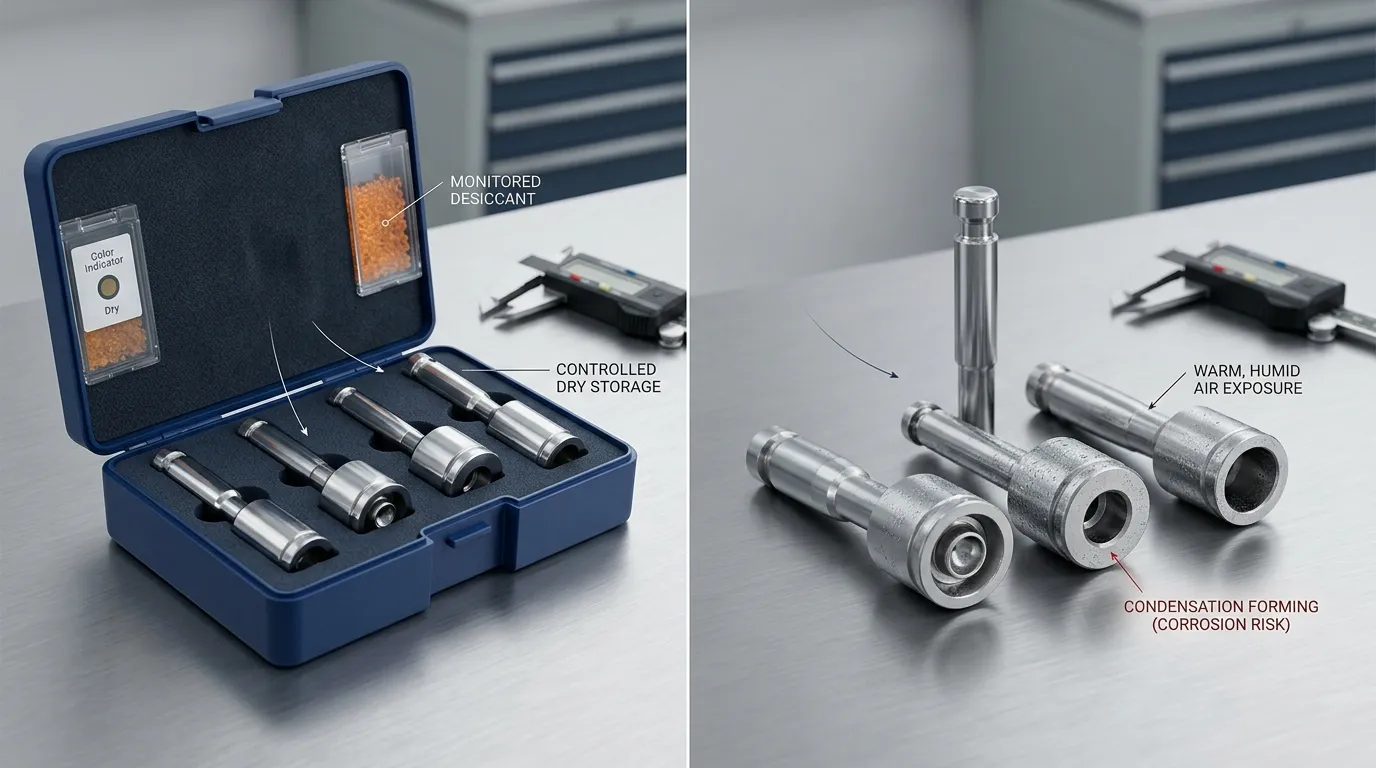
Corrosion risk is influenced by more than room humidity. Relevant factors include:
- Baja perkakas dan perlakuan panas
- Permukaan akhir
- Kondisi lapisan
- Sisa produk atau bahan kimia pembersih
- Garam dari penanganan
- Air yang tertahan
- Polutan di udara
- Perubahan suhu
- Durasi penyimpanan
- Kompatibilitas pelindung
Complete drying remains the first corrosion-control step. A cabinet or desiccant cannot reliably compensate for tools stored while still damp.
The storage area should be clean, kering, and protected from repeated environmental changes. Avoid locations close to wash stations, uncontrolled exterior walls, chemical vapors, leaking utilities, or frequently opened exterior doors.
Room or enclosure limits should be defined through a facility risk assessment using actual tooling materials, pelapisan-lapisan, local climate, storage duration, and monitoring capability. One temperature or relative-humidity value should not be presented as universally correct for every facility.
Cegah Kondensasi Selama Transisi Ruangan dan Wadah
Condensation can form when cooler metal is exposed to warmer, humid air. This means tooling can become wet even when it was dry inside its previous room or container.
Risk increases when:
- Kotak penyimpanan dingin segera dibuka di ruangan yang lebih hangat
- Perkakas bergerak antar area dengan perbedaan suhu yang besar
- Ruangan ber-AC menerima udara luar yang lembab
- Kontainer dibuka berulang kali selama fluktuasi lingkungan
Where a significant temperature difference exists, follow an approved equilibration procedure before opening the enclosure. If visible moisture appears, stop the process, dry and reinspect the tooling, and determine whether the event requires quarantine.
Panduan pelestarian logam umum dari AS. National Park Service identifies moisture, kontaminan, temperature changes, and unsuitable storage materials as factors that can accelerate metal deterioration. Those principles are useful for understanding corrosion mechanisms, although pharmaceutical facilities must establish their own qualified limits and procedures.
Use Protectants, Desiccants, and VCI Materials Carefully
A storage protectant may reduce corrosion risk, but it must be selected for the specific tooling and storage conditions.
Confirm:
- Kompatibilitas baja perkakas dan pelapis
- Ketebalan aplikasi
- Durasi penyimpanan yang dimaksudkan
- Implikasi kontak produk
- Prosedur penghapusan
- Kompatibilitas yang lebih bersih
- Risiko residu
- Persyaratan inspeksi
An operating lubricant intended for short production intervals may not provide suitable long-term corrosion protection. sebaliknya, a heavy long-term protectant may require more extensive removal and re-cleaning before the tool returns to production.
Desiccants can help inside an appropriately sealed enclosure, Namun, mereka tidak bebas perawatan. Their performance depends on:
- Kebocoran penutup
- Kapasitas pengering
- Beban kelembaban yang ada
- Durasi penyimpanan
- Jadwal penggantian atau regenerasi
- Condition indicators, where used
Volatile corrosion inhibitor materials may be considered for some enclosed applications, but their compatibility, safety documentation, replacement interval, coating effects, and product-contact implications must be reviewed first.
| Kontrol | Penggunaan yang tepat | Batasan utama |
|---|---|---|
| Pelindung penyimpanan | Film pelindung sementara pada permukaan logam yang kompatibel | Must be removable and compatible with the tool, pelapisan, cleaner, and product-contact process |
| Pengering | Pengurangan kelembaban di dalam penutup tertutup yang sesuai | Menjadi tidak efektif saat jenuh atau digunakan dalam wadah yang bocor |
| Bahan VCI | Kontrol korosi tambahan di lingkungan tertutup | Requires chemical, pelapisan, keamanan, and process compatibility review |
| Kotak tertutup | Perlindungan lokal dari debu dan perubahan lingkungan | Does not compensate for wet tooling, failed seals, or missing monitoring |
Pilih sistem penyimpanan yang sesuai dengan set alat dan risiko
The best storage system depends on tool geometry, set size, storage duration, room conditions, access frequency, and contamination controls.
Evaluate these features before selecting a tray, box, drawer, or cabinet:
- Posisi individu untuk setiap komponen
- Dukungan stabil tanpa tekanan pada permukaan kerja
- Dimensi format perkakas yang sesuai
- Bahan sisipan yang dapat dibersihkan dan tidak rontok
- Perlindungan dari debu dan kontak yang tidak disengaja
- Kapasitas beban yang memadai
- Pelabelan yang jelas dan penomoran posisi
- Pengoperasian laci atau tutup yang aman
- Inspeksi visual yang mudah
- Kontrol akses jika diperlukan
- Kompatibilitas dengan pelindung dan bahan pembersih
Tooling format matters because inserts designed for one punch diameter, panjang, or head geometry may not safely support another.
Compare Trays, Boxes, Drawers, Cabinets, and Transport Cases
| Opsi penyimpanan | Penggunaan terbaik | Kekuatan | Batasan dan pemeriksaan |
| Baki yang dipasang | Mengatur organisasi dan pemisahan individu | Good visibility, counting, and position control | Mungkin memerlukan penutup luar untuk perlindungan debu atau kelembapan |
| Kotak tertutup | Perlindungan lingkungan lokal | Membatasi pertukaran debu dan kelembaban eksternal | Kondisi segel dan kelembaban internal masih memerlukan pemantauan |
| Penyelenggara laci | Akses yang sering dan penyimpanan set terpusat | Pengambilan yang efisien dan penomoran posisi yang jelas | Gerakan laci tidak boleh memungkinkan komponen bergeser |
| Kabinet perkakas | Organisasi ruang alat pusat | Mendukung kontrol akses dan beberapa set | Still requires suitable trays, sisipan, and environmental control |
| Kasus transportasi | Pergerakan yang dilindungi antar area kerja | Mengurangi risiko penanganan dan jatuh | Mungkin tidak cocok untuk penyimpanan yang diperpanjang tanpa evaluasi lebih lanjut |
A cabinet alone is not the storage control. The complete system includes the room, enclosure, sisipkan, identification method, protectant, monitoring process, and release procedure.
Mengidentifikasi, Track, and Segregate Every Tool Set
Physical protection is only one part of tablet tooling storage best practices. A perfectly preserved tool can still create a production problem if it is mixed with another set, stored under the wrong status, or returned without a complete record.
Each punch-and-die set should have:
- Pengidentifikasi set unik
- Lokasi penyimpanan yang ditentukan
- Jumlah komponen yang diketahui
- Posisi bernomor jika berguna
- Status pembersihan dan inspeksi yang tercatat
- Rincian pelindung yang digunakan
- Tanggal penyimpanan
- Persyaratan peninjauan atau inspeksi ulang
- Status yang dibebaskan atau dikarantina yang jelas
Catat informasi yang diperlukan untuk mengambil dan melepaskan set
A practical storage record may contain:
| Bidang rekam | Tujuan |
| ID set perkakas | Menghubungkan komponen ke spesifikasi dan riwayat yang benar |
| Referensi produk atau gambar | Mencegah penggunaan dengan desain tablet yang salah atau pengaturan tekan |
| Format perkakas | Mengonfirmasi kompatibilitas penyelenggara dan peralatan |
| Jumlah komponen | Mengidentifikasi alat yang hilang atau diganti |
| Tanggal pembersihan | Menunjukkan kapan persiapan selesai |
| Status inspeksi | Mengonfirmasi apakah set diterima atau dibatasi |
| Pelindung yang digunakan | Mendukung keputusan kompatibilitas dan penghapusan |
| Lokasi penyimpanan | Membuat pengambilan terkontrol dan dapat dilacak |
| Persyaratan ulasan | Menunjukkan kapan kondisi yang disimpan harus dinilai ulang |
| Status saat ini | Mencegah perkakas yang dikarantina dipasang |
The exact fields should match the facility’s quality system. Facilities operating under U.S. drug-manufacturing requirements can also review 21 CFR 211.182 for equipment cleaning, pemeliharaan, and use-record expectations.
Quarantine Damaged, Incomplete, or Unidentified Tooling
Normal storage is not appropriate when the set has:
- Korosi yang terlihat
- Keripik, dents, goresan, or impact marks
- Embossing rusak
- Dugaan kegagalan lapisan
- Komponen yang hilang
- Identitas yang tidak dapat dibaca atau tidak pasti
- Status pembersihan tidak diketahui
- Peristiwa kelembaban yang tidak dapat dijelaskan
- Wadah yang rusak atau segel yang rusak
- Pelindung yang tidak diverifikasi
Record the reason for quarantine and keep the tooling physically or electronically separated from released sets. Refer it for qualified assessment rather than returning it to the press.
Detailed repair, refurbishment, and replacement limits belong in a separate engineering decision process. Once that resource is available, the quarantine section can link readers to the planned tablet tooling refurbishment criteria page.
Sesuaikan kontrol untuk penyimpanan jangka pendek dan jangka panjang
Storage between nearby production runs may not require the same preservation method as tooling held for an extended or uncertain period. The distinction should be defined by the facility rather than by a universal number of days.
| Faktor keputusan | Interval penyimpanan yang lebih pendek | Interval penyimpanan yang lebih lama atau tidak pasti |
| Penutup | Protected tray, drawer, or approved box may be sufficient | Penutup yang lebih terkontrol mungkin diperlukan |
| Pelindung | Perlindungan yang disetujui cahaya mungkin sesuai dengan interval yang ditentukan | Pelindung berdurasi panjang mungkin perlu dievaluasi |
| Pemantauan lingkungan | Ikuti kontrol ruang alat normal | Peningkatan penutup atau pemantauan ruangan dapat dibenarkan |
| Pengering atau VCI | Seringkali tidak perlu kecuali lingkungan membutuhkannya | Dapat dievaluasi untuk penyimpanan tertutup yang kompatibel |
| Inspeksi | Periksa sebelum penggunaan berikutnya | Menjadwalkan tinjauan kondisi tersimpan yang didokumentasikan |
| Kembali ke layanan | Verifikasi kondisi dan hapus perlindungan sesuai kebutuhan | Pembersihan ulang dan pemeriksaan yang lebih rinci mungkin diperlukan |
Bahan, pelapisan, local climate, storage history, and product-contact requirements should control the decision. Longer storage does not justify applying excessive grease or an incompatible corrosion inhibitor.
Periksa perkakas yang disimpan dan lepaskan sebelum digunakan kembali
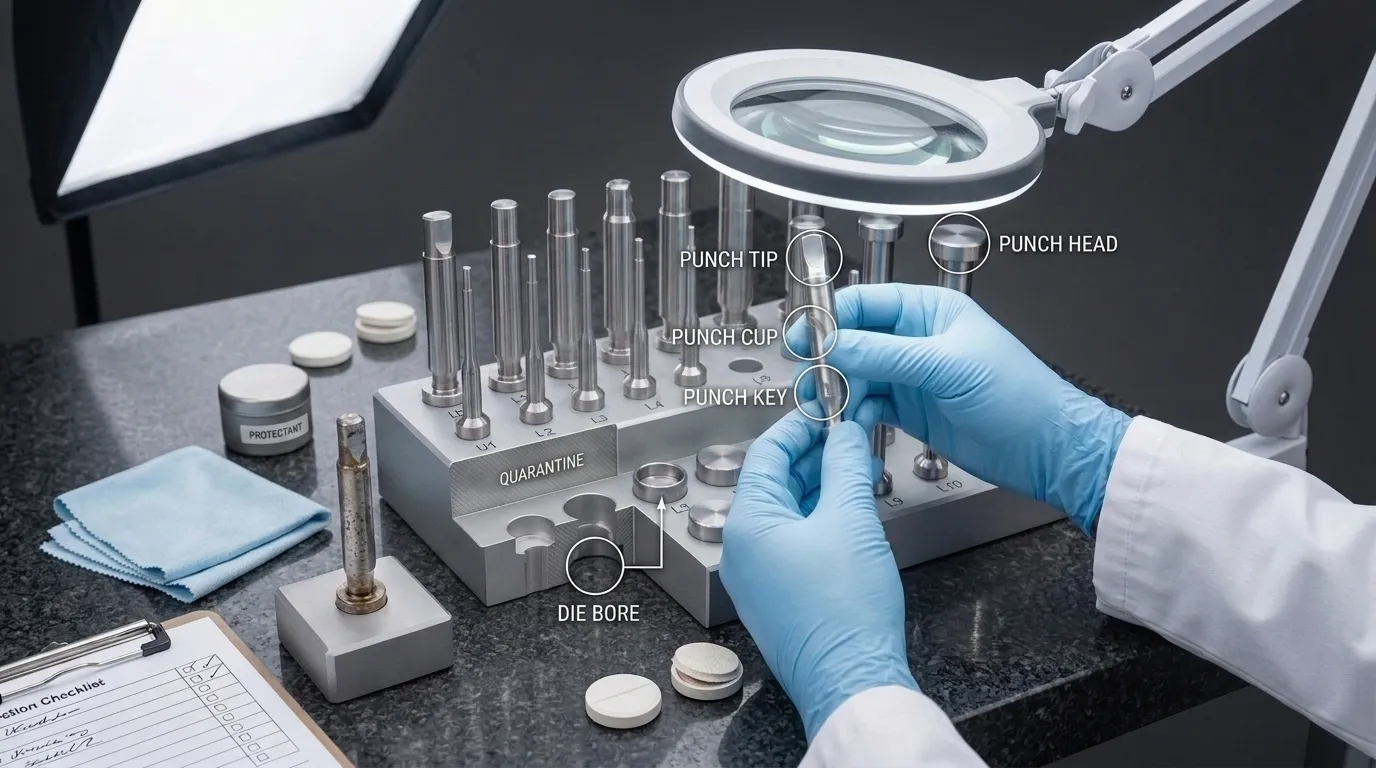
Storage controls can fail. Containers can leak, desiccants can become saturated, protectants can break down, labels can detach, and components can shift.
Inspection frequency should consider:
- Durasi penyimpanan
- Bahan alat dan lapisan
- Stabilitas ruangan
- Jenis penutup
- Instruksi Pelindung
- Kondisi pengering
- Peristiwa korosi sebelumnya
- Frekuensi akses
- Kunjungan lingkungan
Menjadwalkan pemeriksaan kondisi tersimpan berbasis risiko
During a stored-condition review, check for:
- Korosi atau pewarnaan
- Kelembaban yang terlihat
- Debu atau residu
- Segel rusak
- Pengering yang habis
- Komponen yang digeser atau bersentuhan
- Masukkan kerusakan
- Alat yang hilang
- Label salah
- Perubahan status atau lokasi yang tidak dapat dijelaskan
Do not assign one universal monthly, quarterly, or annual interval. The inspection schedule should be documented and justified by the actual risk.
Selesaikan Pemeriksaan Rilis Pra-Penggunaan
Before installation:
- Confirm the tool-set identity and specification.
- Reconcile the component count.
- Inspect punch tips, cangkir, kepala, keys, die edges, and die bores.
- Check for corrosion, perubahan warna, kelembapan, keripik, and coating damage.
- Remove the storage protectant using the approved method.
- Re-clean the tooling when required.
- Confirm that the set has released status.
- Record completion of the inspection.
An intact box does not prove that the tooling inside is ready for production.
Hindari Kesalahan Umum Penyimpanan Perkakas Tablet
| Kesalahan | Risiko yang diciptakan | Kontrol yang lebih baik |
| Menyimpan alat saat lembab | Korosi, staining, atau kontaminasi | Verifikasi pengeringan lengkap sebelum perlindungan |
| Mengoleskan minyak di atas residu | Menjebak kontaminasi dan menyembunyikan kondisi | Bersihkan dan periksa terlebih dahulu |
| Menggunakan tempat sampah lepas bersama | Dampak, scratching, and mixed components | Gunakan posisi yang pas secara individual |
| Menggunakan busa kotor atau menumpahkan | Particles, retained moisture, and abrasion | Use cleanable, compatible inserts |
| Dengan asumsi alat berlapis tidak memerlukan perlindungan | Kerusakan lapisan dan area yang terbuka mungkin masih memburuk | Ikuti panduan khusus lapisan |
| Meninggalkan pengering tanpa batas waktu | Keyakinan palsu setelah saturasi | Periksa dan ganti sesuai dengan rencana penutup |
| Mencampur set yang dirilis dan dikarantina | Pemasangan perkakas yang tidak sesuai secara tidak sengaja | Gunakan status yang jelas dan pemisahan fisik |
| Mengabaikan transisi suhu | Kondensasi pada permukaan logam yang lebih dingin | Kontrol keseimbangan dan periksa setelah tamasya |
| Mengembalikan alat langsung dari penyimpanan | Undetected damage, residue, or identity errors | Selesaikan pemeriksaan rilis pra-penggunaan yang terdokumentasi |
Membangun proses penyimpanan ke dalam SOP ruang alat
A repeatable tablet tooling storage procedure should define:
- Personel yang bertanggung jawab
- Metode pembersihan dan pengeringan yang disetujui
- Kriteria inspeksi dan status
- Wadah yang disetujui dan bahan sisipan
- Metode pemilihan dan penghapusan pelindung
- Batas lingkungan yang ditentukan fasilitas
- Peralatan pemantauan dan frekuensi tinjauan
- Kontrol lokasi penyimpanan
- Catatan yang diperlukan
- Prosedur karantina dan eskalasi
- Respons kunjungan lingkungan
- Tanggung jawab rilis pra-penggunaan
- Persyaratan pelatihan dan kontrol perubahan
Regulations and guidance differ by market and application. Use FDA and WHO sources as applicable references, then align the final SOP with local requirements, the facility’s quality system, and supplier documentation.
Konfirmasikan persyaratan khusus material dengan pemasok perkakas
General storage guidance cannot replace material- and design-specific information. Before approving a protectant, sisipkan, or long-term preservation method, mengonfirmasi:
- Baja perkakas yang sebenarnya
- Pelapisan atau perawatan permukaan
- Pembatasan kimia
- Pelindung yang Kompatibel
- Metode penghapusan yang disetujui
- Persyaratan dukungan untuk ujung halus atau embossing
- Batasan penyimpanan apa pun untuk geometri yang tidak biasa
SunshinePro perkakas tekan tablet page identifies punches and dies, high-speed steel as an available material, and customization based on size, material, and press or mold pairing. The company also states that custom tooling can be processed from drawings or samples.
For material-specific questions, replacement tooling, or a custom punch-and-die requirement, hubungi SunshinePro with the tooling drawing, contoh, informasi material, and application details.
Bagikan:


Ditulis oleh Sunshine
di Sunshine, Kami adalah produsen dan pemasok profesional komponen cetakan presisi, menawarkan berbagai produk untuk aplikasi stamping dan cetakan injeksi. Fokus utama kami adalah mencetak cetakan, pin dan lengan ejector, serta tiang panduan dan bushing. Dengan pemesinan CNC canggih, kontrol kualitas ketat, dan kemampuan produksi yang kuat, kami memastikan keandalan, suku cadang presisi tinggi, bersama dengan komponen standar yang tersedia untuk pasokan global yang cepat dan efisien.
BERITA
DAPATKAN LAYANAN
Dengan suku cadang berkualitas untuk memenuhi setiap anggaran dan staf ramah yang terlatih untuk membuat kunjungan Anda menjadi informatif dan tanpa repot.
