



Desain Perforasi Punch Pin untuk Pola Lubang Kecil Berulang
Perforation punch pin design is not simply a matter of choosing a small diameter and a hard material. A reliable design must coordinate the hole pattern, sheet material, geometri punch, support system, combined cutting force, Pembersihan, slug path, and maintenance method.
The challenge becomes greater as hole diameter decreases or more holes are punched during each stroke. A long, unsupported tip may deflect. A dense cluster can exceed press capacity or distort the sheet. Small slugs may clog the die or return to the work surface. The punch therefore has to be designed as part of the complete cutting system.
For broader information about punches, stripper systems, elemen panduan, and other tooling parts, lihat Panduan Komponen Die (disimpulkan). This guide focuses specifically on punch pins used for repeated small-hole patterns.
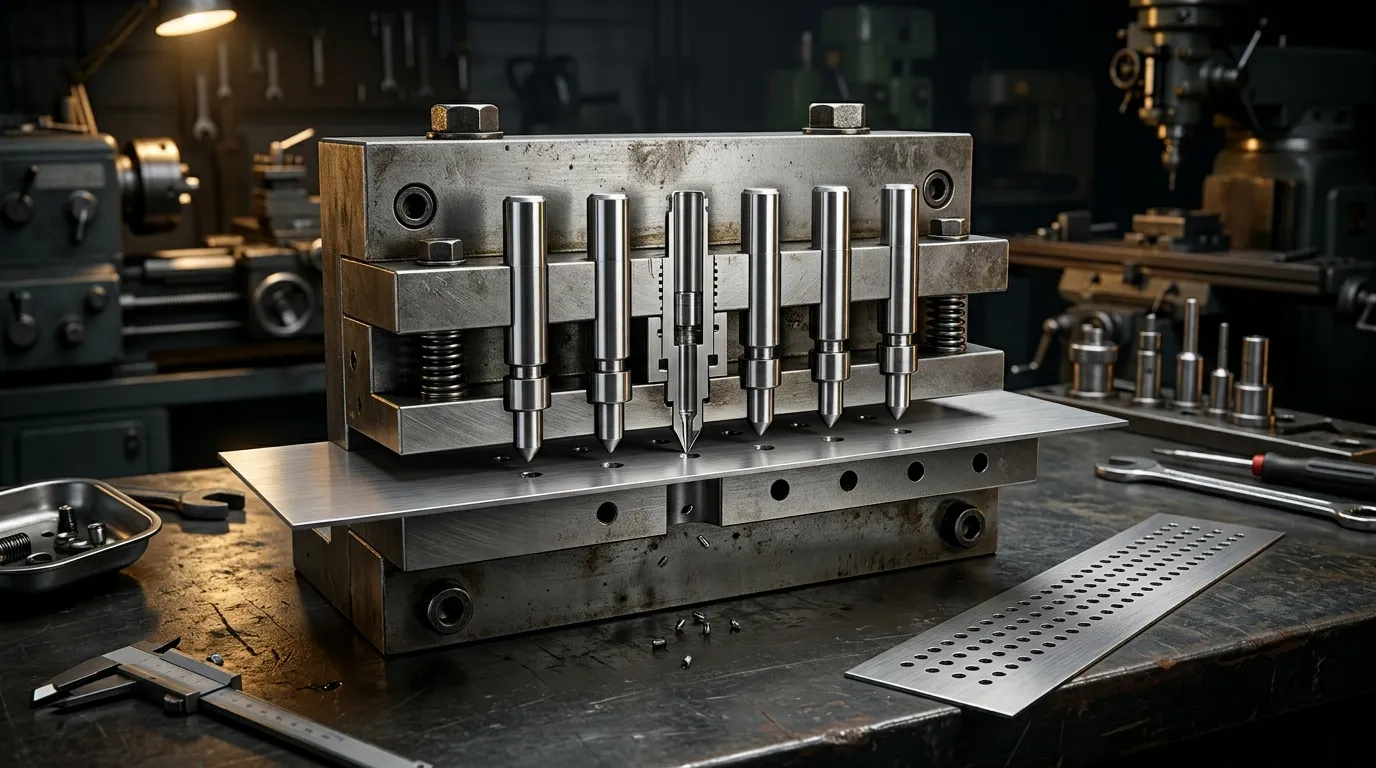
What Must Be Designed Together in a Perforation Punching System?
A perforation punch pin forms one part of a load path that extends through the tool:
- The cutting tip enters the sheet.
- The punch shank transfers the cutting load upward.
- The punch plate locates and retains the pin.
- The backing plate supports the punch against axial reaction.
- The stripper controls the sheet and may guide the punch near its tip.
- The die opening provides the opposing cutting edge.
- The slug passes through the die relief and exits the tool.
A weakness in any one part can affect the entire operation. A strong punch material will not prevent failure if the working tip is too long, the stripper allows lateral movement, or the die opening is misaligned. A correctly sized pin can still produce unstable results if several tips create excessive combined force or if the slug path becomes blocked.
This is why perforation tooling should not be treated as an isolated component-selection exercise. General die construction and die-type decisions are covered more broadly in the Panduan Cetakan Meninju. Ini, the design starts with the repeated hole pattern and works inward toward the punch pin.
Tentukan pola lubang dan persyaratan lembaran sebelum mendesain pin
The working diameter is only one input. Before selecting a pin architecture or material, define the conditions that control the cutting operation.
The design package should include:
- Bahan dan kondisi lembaran
- Ketebalan lembaran nominal dan toleransi ketebalan
- Hole diameter, bentuk, and dimensional tolerance
- Pitch lubang di setiap arah
- Bahan yang tersisa di antara lubang yang berdekatan
- Pattern arrangement, including aligned or staggered rows
- Area terbuka yang diperlukan
- Arah duri dan tinggi duri yang diizinkan
- Persyaratan kerataan lembaran
- Volume produksi yang diharapkan
- Kapasitas pers dan stasiun yang tersedia
- Persyaratan pelumasan dan kebersihan
- Metode penajaman dan penggantian yang direncanakan
These inputs are connected. Changing the sheet thickness affects cutting force, slug geometry, practical hole size, and die clearance. Reducing hole pitch leaves less material between adjacent openings and may weaken both the sheet and the die. Increasing the number of tips raises the combined cut perimeter and total force.
Hole Size, Bahan, and Thickness Set the First Feasibility Check
A small hole is more difficult to punch when its diameter approaches or falls below the sheet thickness. The exact practical limit depends on the work material, punch material, panduan, penyelarasan, tool construction, and required hole quality.
A hard or high-strength sheet generally creates greater cutting load than a softer material of the same thickness. A small punch cross-section must carry that load without bending, mengelupas, or breaking. Guided tooling may support a more demanding diameter-to-thickness relationship than a long, non-guided punch, but guidance does not eliminate the need for sufficient punch strength.
Referensi teknis seperti panduan MISUMI tentang meninju lubang berdiameter kecil emphasize short working sections, stepped support, and controlled slug removal. Supplier ratios can be useful for an early feasibility check, but they should not be treated as universal design limits.
Pitch, Remaining Web, and Flatness Define the Pattern-Level Risk
Hole pitch is the centre-to-centre distance between adjacent perforations. The remaining web, sometimes called the bridge, is the material left between their edges.
A pattern may contain individually feasible holes but still be difficult to manufacture if the web becomes too narrow. Dense perforations can:
- Kurangi kekakuan lembaran lokal
- Melemahkan bahan die di antara bukaan
- Meningkatkan risiko interaksi lubang
- Menghasilkan peregangan lembaran atau gelombang
- Buat pengalengan minyak di panel yang lebih besar
- Konsentrasikan beban pemotongan di satu wilayah alat
Aligned rows and staggered rows do not distribute load in the same way. A staggered pattern may improve open-area distribution or reduce direct alignment of weak sections, but it does not automatically solve distortion. The finished panel’s flatness requirement must be considered with the complete punching sequence.
Pilih arsitektur punch pin yang mendukung ujung kerja kecil
A perforation pin normally contains several functional regions:
- Ujung kerja yang membuat lubang
- Transisi atau bahu di belakang ujung
- Betis yang lebih besar yang mentransfer dan menopang beban
- Fitur retensi yang menemukan pukulan di pelat pukulan
- Tunjangan penyesuaian atau penggilingan ulang jika diperlukan
The small working portion should be only as long as the operation needs. Extra unsupported length increases sensitivity to lateral movement and bending. The required length must still allow suitable penetration, stripper guidance, withdrawal, and future sharpening.
Lurus, Stepped, and Multi-Step Pins Serve Different Section Sizes
| Arsitektur pin | Logika desain khas | Keuntungan utama | Batasan utama |
|---|---|---|---|
| Pin lurus | Bagian kerja dan betis memiliki penampang yang sama atau serupa | Geometri dan pembuatan sederhana | Bagian panjang penuh yang sangat kecil mungkin kurang kekakuan |
| Pin berundak | Ujung kerja kecil ditopang oleh betis yang lebih besar | Dukungan yang lebih baik di belakang bagian pemotongan | Posisi bahu dan transisi membutuhkan desain yang cermat |
| Pin multi-langkah | Beberapa transisi menghubungkan ujung kecil ke tubuh yang jauh lebih besar | Perubahan yang lebih bertahap antara bagian yang sangat berbeda | Geometri dan inspeksi yang lebih kompleks |
Diskusi MISUMI tentang desain pukulan meninju lubang distinguishes straight, berlangkah, and multi-step punches according to the strength and size of the functional section.
A stepped punch is often considered when the required hole is too small for a long straight pin to remain sufficiently rigid. The larger shank provides support, while the smaller section performs the cut. The transition should transfer load without creating an unnecessarily sharp stress concentration.
Panjang Kerja dan Geometri Transisi Mengontrol Defleksi dan Tegangan
Two punches with the same tip diameter can behave very differently if one has a much longer unsupported working section.
As the slender section becomes longer, the pin becomes more vulnerable to:
- Defleksi lateral
- Ketidaksejajaran dengan bukaan die
- Keausan samping yang tidak merata
- Memotong di ujung tombak
- Kerusakan kelelahan
- Membungkuk selama pengupasan
The transition behind the working tip also matters. An abrupt reduction in section can create a highly stressed area. A better-supported transition distributes the load into the larger shank while preserving the required access to the sheet and stripper.
There is no single universal working-length ratio for every material and application. The final geometry must account for penetration, ketebalan lembaran, stripper position, guidance length, regrinding allowance, and the actual load on the tip.
Guide, Mempertahankan, and Back the Punch Through the Full Stroke
Small punches require both axial and lateral support.
The punch plate retains and locates the shank. The backing plate supports the punch against cutting reaction. The stripper controls the sheet during withdrawal and may guide the punch close to the cutting region. These elements must remain aligned with the die opening.
Even a correctly dimensioned pin can fail if the support system allows side loading.
Panduan Penari Telanjang Membatasi Pukulan Berkeliaran di Dekat Ujung Pemotongan
A stripper-guided punch passes through a controlled opening in the stripper plate before entering the sheet. This close support reduces the distance over which the small tip can move laterally.
Catatan teknis MISUMI tentang panduan penari telanjang untuk pukulan pengosongan lubang explains that small punches are especially vulnerable to lateral movement. The stripper can reduce that movement, but only when the stripper itself moves accurately.
If the stripper tilts, shifts, or has excessive clearance, it may transfer error to the punch rather than correcting it. The stripper opening, punch shank, and die opening must therefore be treated as one alignment system.
Pelat Punch dan Pelat Pendukung Melengkapi Jalur Beban Aksial
The punch plate positions the pin, but it may not provide sufficient resistance to concentrated axial load by itself. A small punch head or shank can create high local pressure behind the pin.
A backing plate spreads this reaction into a stronger supporting area. Without adequate backing, the punch may indent or sink into the holder, changing its working height and alignment.
Panduan MISUMI tentang desain pelat pendukung highlights this issue for punches with small supporting cross-sections.
The load path should remain flat, rigid, and correctly located. A hard punch placed against a weak or poorly supported holder can still lose position under repeated loading.
Cocokkan jumlah pin dan pengaturan pola dengan gaya meninju yang tersedia
A cluster punch produces several holes in one stroke. This can reduce the number of press cycles required, but the press must cut the combined perimeter of all engaged tips.
The total load is not determined by hole count alone. It depends on:
- Perimeter pemotongan total yang terlibat
- Ketebalan lembaran
- Ketahanan geser bahan kerja
- Jumlah ujung pemotongan secara bersamaan
- Ketajaman pukulan
- Izin
- Kondisi pengupasan
- Efisiensi alat dan pers
Adding more tips may increase output per stroke, but it also raises cutting load, slug volume, maintenance exposure, and the possibility of sheet distortion.
Estimate Force from Total Cut Perimeter, Not Hole Count Alone
A conceptual punching-force relationship is:
Gaya meninju ≈ perimeter pemotongan total × ketebalan lembaran × ketahanan geser material
For a cluster, the total cut perimeter is the sum of the perimeters of all tips engaged during the same part of the stroke.
This means ten small round holes do not create the same load as ten slots with a much greater combined perimeter. Two patterns with similar open area may also require different force because their edge lengths differ.
Pasangan Presisi panduan meninju cluster uses total cutting perimeter as a central force-planning factor and recommends checking cluster load against the machine and station limits.
The calculation should be treated as an engineering estimate. The actual tool must also account for stripping force, load balance, kondisi pers, and the manufacturer’s tooling limits.
Mengejutkan dan distribusi beban dapat mengurangi masalah tingkat pola
If every adjacent tip enters the material at the same time, cutting load may be concentrated within a small area. This can increase peak force and stretch the sheet around the pattern.
Possible design responses include:
- Membagi pola di lebih dari satu stasiun
- Menggunakan lebih sedikit tip aktif
- Mengatur baris sehingga keterlibatan didistribusikan
- Panjang ujung yang mengejutkan di mana sistem perkakas memungkinkannya
- Menyeimbangkan pola di sekitar pusat alat
- Mengubah urutan meninju
These methods can reduce local concentration, but they may also add tool complexity or change the loading sequence. They must preserve the finished hole locations and part geometry.
Informasi Wilson Tool tentang perforasi dengan alat cluster also identifies sheet stretch and oil-canning as practical concerns in dense perforation work.
Koordinasikan Die Clearance dengan Evakuasi Siput
The punch and die opening form one cutting pair. Clearance between them influences cutting load, fracture behaviour, formasi burr, tool wear, and slug release.
Repeated small-hole patterns make waste handling especially important. A cluster with 20 tips creates 20 slugs during each complete punching cycle. Even when each slug is small, the cumulative waste flow can become substantial.
The die must provide:
- Jarak bebas pemotongan yang cocok
- Memadai negara
- Relief di bawah ujung tombak
- Rute keluar yang berkelanjutan
- Akses untuk inspeksi dan pembersihan
- Perlindungan terhadap resirkulasi siput
Clearance Must Be Verified for the Material, Ketebalan, and Required Edge
Clearance is normally considered per side between the punch and die cutting edges. The appropriate value depends on the sheet material, ketebalan, kondisi tepi yang dibutuhkan, punch condition, and tooling method.
Clearance that is too small may increase force and wear. Clearance that is too large may increase burrs, edge rollover, atau variasi dimensi. As the punch and die wear, effective clearance changes even if the original dimensions remain correct.
For this article, the important point is that the pin diameter cannot be finalized independently from the die opening. Exact clearance values require material- and application-specific calculation and validation.
Setiap lubang tambahan menambahkan siput lain yang harus keluar dengan andal
Small slugs can:
- Akumulasi dalam bagian dadu terbatas
- Jembatan melintasi bagian relief sempit
- Padatkan menjadi penyumbatan
- Patuhi wajah pukulan
- Kembali ke permukaan kerja
- Merusak lembaran selama stroke selanjutnya
The die relief should allow slugs to move away without trapping one another. Tool access should permit cleaning before debris raises the cutting load or damages the punch.
Slug pulling requires particular attention. A slug that follows the punch upward may be pressed back into the sheet or trapped between the tool and workpiece. Geometri, pembersihan, pelumasan, kondisi permukaan, and waste-path design can all influence this behaviour.
Pilih bahan pin dan perawatan permukaan dengan mode kegagalan yang diharapkan
The hardest available punch material is not automatically the best choice. Material selection should respond to the dominant failure risk.
Common risks include:
- Keausan abrasif
- Keausan perekat atau galling
- Chip tepi
- Kerusakan kelelahan
- Deformasi plastik
- Dampak dari ketidaksejajaran
- Korosi atau kerusakan permukaan
A material that resists wear well may be less tolerant of shock or side loading. A tougher material may survive misalignment better but require more frequent sharpening.
baja alat, HSS, and Carbide Balance Wear and Toughness Differently
| Keluarga material | Karakteristik yang berguna | Masalah desain utama |
| Baja perkakas | Broad balance of toughness, ketahanan aus, perlakuan panas, and regrindability | Performa sangat bergantung pada kelas dan perlakuan panas |
| Baja berkecepatan tinggi atau metalurgi serbuk | Dapat memberikan ketahanan aus yang lebih tinggi sambil mempertahankan ketangguhan yang berguna | Biaya dan kesulitan pemesinan dapat meningkat |
| Karbida | Ketahanan aus tinggi dan kekuatan tekan | Lebih sensitif terhadap benturan, mengelupas, and alignment errors |
Carbide may be suitable for stable, abrasif, high-volume applications, but it is not a universal solution for every small hole. A slender carbide tip exposed to side load or impact may chip where a tougher steel punch would survive.
The selection should consider the sheet material, working-tip diameter, panjang tidak didukung, panduan, pelumasan, kondisi pers, and previous failure history.
SunshinePro pin punch kustom daftar halaman SKH51, SKH9, DC53, ASP-grade materials, and carbide among its stated material options. Final suitability still has to be confirmed against the actual drawing and application.
Permukaan Akhir, Lapisan, and Lubrication Address Surface Interaction
Surface finish influences friction, pengambilan material, release, and the condition of the substrate beneath a coating. A smoother working surface may help reduce adhesion in suitable applications, but finish alone cannot correct an unsupported tip or misaligned die.
Coatings such as TiN, TiCN, and DLC may be considered for selected wear or friction conditions. Their value depends on:
- Substrat pukulan
- Bahan benda kerja
- Persiapan permukaan
- Geometri tepi
- Pelumasan
- Suhu
- Benturan dan pemuatan samping
- Adhesi lapisan
A coating should not be used as a structural repair. It cannot compensate for excessive working length, poor stripper guidance, weak backing, or incorrect clearance.
Lubrication is also part of the system. It can reduce friction, keausan perekat, and stripping resistance, but the lubricant must be compatible with the work material, downstream process, and cleanliness requirements.
Design the Tool for Replacement, Mengasah, and Inspection
Perforation tooling should be serviceable before the first production run begins. A design that performs well initially but cannot be repaired economically may create unnecessary downtime later.
The maintenance plan should address:
- Penggantian pin individu
- Ketersediaan tip cadangan
- Tunjangan penajaman
- Penyesuaian panjang setelah penggilingan ulang
- Akses ke pin yang dipertahankan
- Identifikasi tip
- Titik inspeksi
- Batas penggantian
Alat multi-tip tetap dan ujung yang dapat diganti membuat model perawatan yang berbeda
A fixed multi-tip punch may be compact and mechanically simple. If one tip is damaged, namun, the repair may affect the complete tool.
Replaceable-tip systems allow individual punches to be changed without discarding the whole cluster body. Wilson Tool describes replaceable configurations among its perforation-tool options.
Replaceable tips are not suitable for every pattern. Very close spacing may leave insufficient room for individual retention features. The design must also provide access for removal, accurate location after replacement, and a practical spare-parts system.
The best configuration depends on pattern density, frekuensi pemeliharaan, tool size, and the cost of replacing one damaged position compared with servicing the complete assembly.
Penggilingan ulang berubah lebih dari ujung tombak
Sharpening removes material from the cutting face. This changes the punch length and may alter penetration, penyesuaian, stripper relationship, or the available guided length.
After regrinding, memeriksa:
- Diameter atau profil ujung
- Kondisi mutakhir
- Panjang kerja yang tersisa
- Kelurusan
- Konsentrisitas antara ujung dan betis
- Kondisi transisi
- Kerusakan permukaan
- Fitur retensi
- Panjang keseluruhan atau posisi penyesuaian
A pin should not remain in service merely because its edge can still be sharpened. If the remaining geometry no longer provides sufficient support or alignment, replacement may be safer than another regrind.
Mendiagnosis masalah pola dengan meninjau variabel desain di belakangnya
Production symptoms rarely identify one guaranteed root cause. They do indicate which design relationships should be checked first.
| Gejala produksi | Kemungkinan penyebab desain | Item untuk ditinjau |
| Punch wandering atau variasi posisi lubang | Long unsupported tip, weak stripper guidance, ketidaksejajaran | Panjang kerja, stripper clearance, penyelarasan pelat, konsentrisitas |
| Kerusakan pukulan berulang | Excessive force, pemuatan samping, konsentrasi tegangan, ketangguhan yang tidak mencukupi | Tip length, transisi, material, pembersihan, press alignment |
| Chip tepi | Brittle material, dampak, poor edge condition, kontak tidak merata | Kelas bahan, perlakuan panas, mukul muka, penyelarasan |
| Pertumbuhan duri yang cepat | Punch or die wear, changing effective clearance | Cutting edges, Pembukaan, interval penajaman |
| Galling atau pengambilan material | Bahan kerja perekat, poor finish, unsuitable lubrication | Permukaan akhir, pelapisan, pelumas, pembersihan |
| Menarik siput | Adhesi, ruang yang tidak sesuai, poor release conditions | Pukulan wajah, Pembukaan, pelumas, slug path |
| Penyumbatan | Bantuan terbatas atau akumulasi siput yang berlebihan | Negara, bantuan, exit path, cleaning access |
| Lubang tidak rata di seluruh cluster | Unbalanced load, different tip lengths, pembelokan pelat | Tip projection, backing support, tool rigidity |
| Lembaran bergelombang atau pengalengan minyak | Dense pattern, concentrated engagement, insufficient web | Pitch, pattern sequence, active tip count |
| Beban tekan yang berlebihan | Too much simultaneous cut perimeter, dull edges, pembersihan yang buruk | Pin count, cutting perimeter, material, kondisi tepi |
For a broader review of fractured or chipped punches, lihat kerusakan pukulan pada cetakan stamping. The focus here should remain on the design variables created by small diameters and repeated patterns.
Siapkan Gambar Siap Pemasok dan Paket RFQ
A supplier cannot evaluate a perforation application from the punch diameter alone. The same nominal pin may behave very differently in thin aluminium, high-strength steel, lembaran berlapis, or a dense multi-tip cluster.
Paket RFQ yang berguna harus mencakup:
- Bahan dan kondisi benda kerja
- Ketebalan dan toleransi nominal
- Hole shape, dimensi, dan toleransi
- Gambar pola penuh
- Pitch dan web yang tersisa
- Arah duri yang diperlukan
- Persyaratan kerataan atau distorsi
- Niat alat ujung tunggal atau cluster
- Diameter dan panjang ujung kerja
- Dimensi betis
- Geometri langkah dan transisi
- Metode retensi
- Die-opening and clearance information, jika sudah didefinisikan
- Jenis tekan dan kapasitas yang relevan
- Volume produksi
- Kondisi pelumasan
- Riwayat kegagalan saat ini untuk proyek pengganti
- Bahan yang diminta dan perlakuan panas
- Persyaratan permukaan akhir atau pelapis
- Karakteristik inspeksi yang diperlukan
- Strategi penggilingan ulang dan pin cadangan
- Kriteria revisi dan penerimaan gambar
Include the Pattern, Pers, and Failure History—not Only the Pin Diameter
For a replacement project, provide the complete pattern and production context wherever possible. Useful supporting information may include:
- Foto pukulan yang aus atau patah
- Gambar lembaran yang rusak
- Lokasi kegagalan dalam pola
- Riwayat penajaman saat ini
- Perkembangan duri
- Bukti penyumbatan siput
- Perubahan tekan beban
- Dimensi pukulan dan cetakan yang ada
This information helps distinguish a material problem from a geometry, penyelarasan, pembersihan, or waste-flow problem.
Konfirmasi Ruang Lingkup Manufaktur dan Kriteria Penerimaan Sebelum Produksi
The RFQ should state whether the supplier is being asked to:
- Membuat pin ke gambar yang disetujui
- Tinjau kemampuan manufaktur geometri pin
- Merekomendasikan bahan atau lapisan
- Menghasilkan pin pengganti dari sampel
- Dokumentasi inspeksi pasokan
- Berpartisipasi dalam desain cetakan atau aplikasi yang lebih luas
These are different scopes of responsibility.
SunshinePro menyatakan bahwa ia menghasilkan pin punch kustom from customer drawings and lists CNC machining, EDM, penggilingan presisi, perlakuan panas, and optional coatings on the product page. Project-specific material, toleransi, menyelesaikan, coating suitability, and inspection requirements should still be confirmed against the drawing.
For a technical review or quotation, provide the pattern drawing, sheet material and thickness, geometri punch, press information, and any current failure details through the Halaman kontak SunshinePro.
Bagikan:


Ditulis oleh Sunshine
di Sunshine, Kami adalah produsen dan pemasok profesional komponen cetakan presisi, menawarkan berbagai produk untuk aplikasi stamping dan cetakan injeksi. Fokus utama kami adalah mencetak cetakan, pin dan lengan ejector, serta tiang panduan dan bushing. Dengan pemesinan CNC canggih, kontrol kualitas ketat, dan kemampuan produksi yang kuat, kami memastikan keandalan, suku cadang presisi tinggi, bersama dengan komponen standar yang tersedia untuk pasokan global yang cepat dan efisien.
BERITA
DAPATKAN LAYANAN
Dengan suku cadang berkualitas untuk memenuhi setiap anggaran dan staf ramah yang terlatih untuk membuat kunjungan Anda menjadi informatif dan tanpa repot.
