



Pin Punch untuk Stamping Stainless Steel: Pilihan Material dan Pelapisan
There is no single best material or coating for punch pins used in stainless steel stamping. The right combination depends on the stainless grade and condition, ketebalan lembaran, geometri punch, volume produksi, pelumasan, Penyesuaian, pembersihan, and the failure mode already appearing in production.
A punch substrate provides the bulk toughness, kekuatan tekan, and edge support. Heat treatment establishes its usable hardness and fracture resistance. Surface finish affects friction and material pickup. The coating or surface treatment then modifies wear, panas, and sliding behavior. Choosing only one of these elements rarely solves the complete problem.
This guide focuses on punch pins used to pierce or blank stainless steel sheet. It does not assume that the punch itself must be made from stainless steel. Untuk informasi lebih luas tentang tipe die, system-level material selection, pembersihan, toleransi, dan sumber daya, lihat Panduan Cetakan Meninju (disimpulkan).
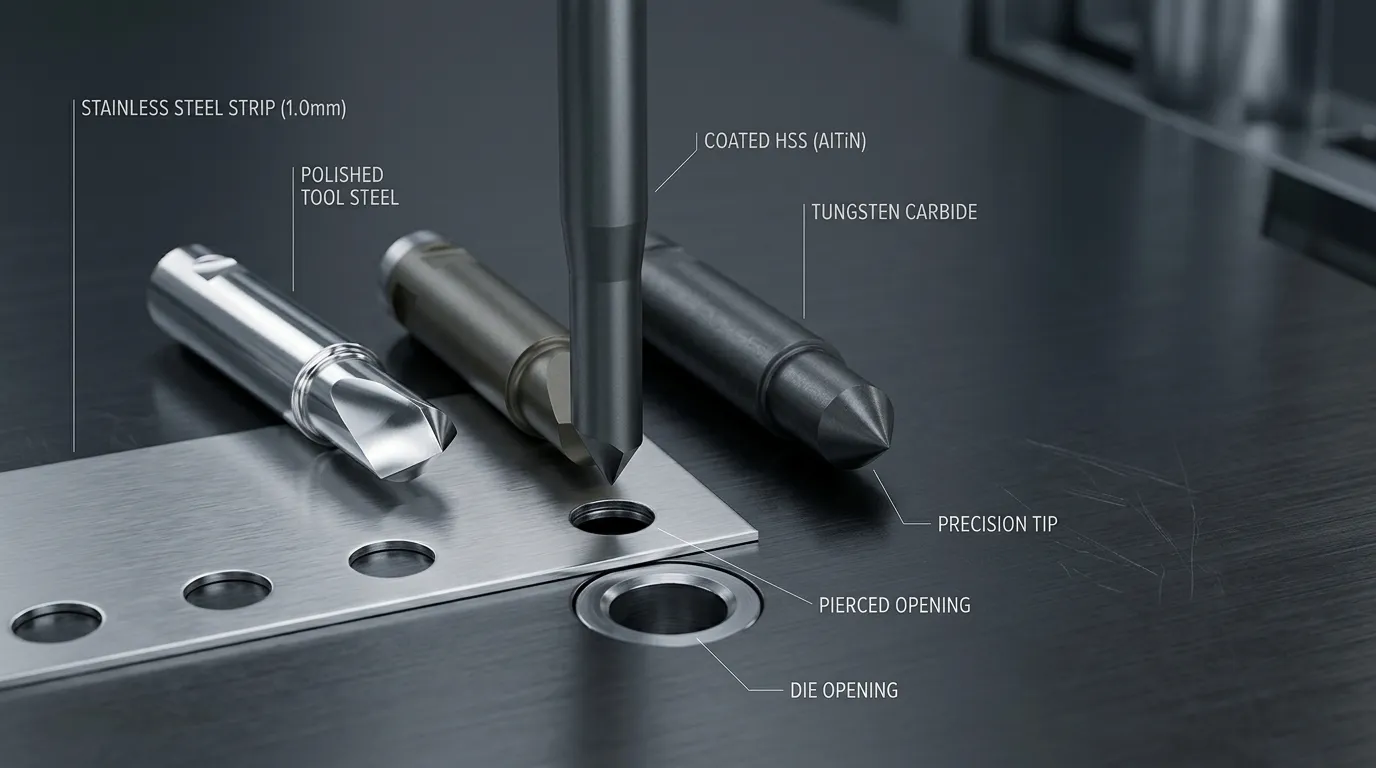
Mengapa Stainless Steel Mengubah Pemilihan Punch-Pin
Stainless steel is not one uniform work material. Austenitic, ferritic, martensitic, and duplex grades have different mechanical properties and forming behavior. Itu WorldScarUlasan Stainless Keluarga Stainless Steel is useful background, but the tooling decision must go further than identifying the family name.
The supplier or tool engineer should know:
- the exact stainless grade;
- ketebalan lembaran;
- temper, kekerasan, or tensile condition;
- kondisi permukaan;
- pierced-hole or blank geometry;
- expected production quantity;
- lubrication method or restrictions;
- current punch material and coating;
- the actual failure seen in production.
Stainless applications often create high contact pressure, gesekan geser, and heat at the punch surface. Under unfavorable conditions, workpiece material can transfer onto the punch. This adhesive wear process is commonly described as galling or material pickup.
Tinjauan sejawat tentang galling dalam pembentukan logam explains that friction, kondisi permukaan, tekanan, suhu, and wear development interact during the process. Once pickup begins, the roughened punch surface can attract more material, increase stripping force, damage the sheet surface, and accelerate further wear.
Stainless sheet may also work-harden near the cutting zone. Thicker or stronger material raises the load on the cutting edge. These conditions make it risky to choose a punch only by nominal hardness.
Pilih substrat pukulan sebelum memilih lapisan
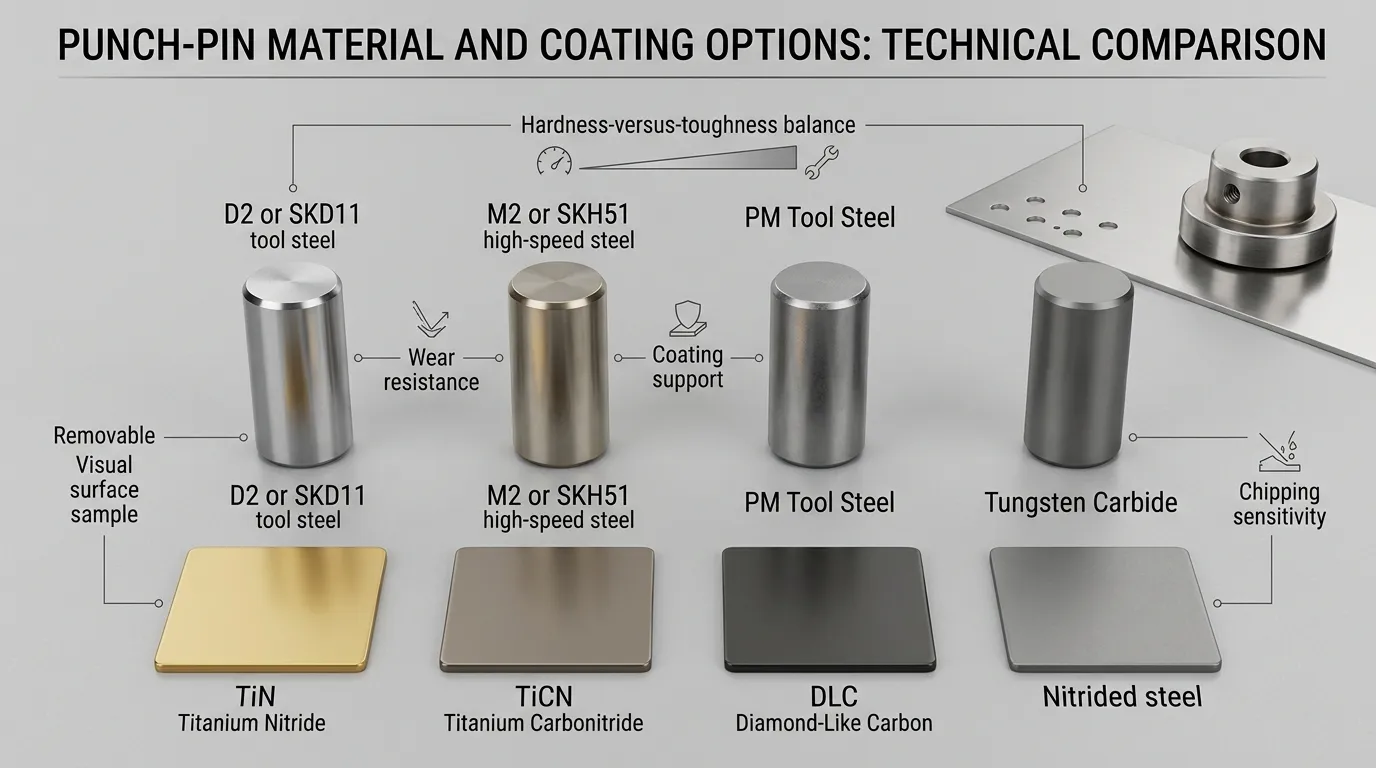
The coating is supported by the material underneath it. A hard coating on an unsuitable, poorly heat-treated, or damaged substrate can still crack, delaminate, chip, or fail with the cutting edge.
The main punch-material options should be compared using several properties:
| Substrat pukulan | Kekuatan utama | Batasan utama | Alasan khas untuk mempertimbangkannya |
|---|---|---|---|
| Baja perkakas tipe D2 atau SKD11 | Ketahanan aus, kekuatan tekan, stabilitas dimensi | Can be less tolerant of impact, pembelokan, or sharp stress concentrations than tougher grades | Geometri stabil dan produksi yang dipimpin oleh keausan sedang |
| M2, SKH51, or SKH9 HSS | Better balance of wear resistance, ketangguhan, dan ketahanan panas | Higher cost than conventional tool steel; still dependent on correct heat treatment | Stainless, thicker sheet, coated punches, or higher production demands |
| Baja perkakas PM | Keseimbangan keausan-ketangguhan yang kuat dan struktur mikro yang lebih seragam | Biaya material premium dan persyaratan pemrosesan khusus kelas | Ketika baja konvensional aus terlalu cepat tetapi karbida terlalu rapuh |
| Baja perkakas tahan guncangan | Ketangguhan tinggi dan ketahanan terhadap fraktur terkait benturan | Ketahanan aus yang lebih rendah daripada tingkat aus paduan kuat | Terkelupas atau benturan lebih penting daripada keausan bertahap |
| Tungsten karbida | Very high hardness, kekuatan tekan, dan ketahanan aus | Brittle under misalignment, kejutan, pembelokan, or poor edge support | Produksi keausan tinggi yang stabil dengan perkakas kaku |
| Baja perkakas tahan karat seperti SUS420 atau SUS440 | Ketahanan korosi dan kemampuan pemolesan | Tidak secara otomatis substrat terbaik untuk menusuk lembaran stainless | Lingkungan atau aplikasi korosif di mana pukulan itu sendiri membutuhkan ketahanan korosi |
D2 or SKD11 for Stable, Wear-Led Applications
D2-class cold-work tool steel is widely used where wear resistance and compressive strength are important. Material documentation for BÖHLER K110, a D2-class steel, lists stamping and blanking among its applications and emphasizes wear resistance and dimensional stability.
D2 or SKD11 may be a reasonable starting point when:
- the punch has a robust cross-section;
- alignment and clearance are controlled;
- production volume is moderate;
- gradual wear is the main concern;
- sudden chipping or bending is not occurring.
It becomes a weaker choice when the punch is very slender, has sharp corners, experiences side loading, or breaks before the cutting edge wears out. Dalam kasus-kasus tersebut, additional hardness may make the problem worse rather than better.
M2, SKH51, or SKH9 When Toughness and Heat Resistance Matter More
High-speed steel is commonly evaluated when the punch needs a stronger balance of wear resistance, ketangguhan, and resistance to heat generated during repeated cycling.
Bimbingan teknis dari CONIC pada bahan perkakas associates M2-type material with stainless steel, thicker sheet, coating use, and larger production quantities. That does not make M2 a universal answer, but it explains why HSS often appears in stainless stamping recommendations.
SunshinePro pukulan baja berkecepatan tinggi page lists SKH51 and SKH9 among its material options, along with vacuum heat treatment, penggilingan presisi, EDM, and optional TiN or TiCN coatings. These are company-specific product options, not fixed specifications for every application.
HSS is worth evaluating when:
- D2 wears or chips too quickly;
- surface heat is significant;
- the punch will receive a PVD coating;
- production volume justifies a higher-cost substrate;
- the geometry needs more fracture resistance than conventional wear steel provides.
Baja Perkakas PM untuk keseimbangan keausan-ketangguhan yang lebih tinggi
Powder-metallurgy tool steels are useful when both wear and fracture resistance matter. Their more uniform microstructure can provide a better combination of properties than many conventionally produced tool steels.
Misalnya, the manufacturer describes BÖHLER K490 MICROCLEAN as a PM cold-work steel combining wear resistance, kekuatan tekan, ketangguhan, and dimensional stability for applications that include stamping and blanking.
PM steel may be justified when:
- conventional D2-type steel wears too quickly;
- HSS does not provide the required service interval;
- carbide chips under the existing geometry or loading;
- downtime costs more than the material upgrade;
- repeated regrinding and stable dimensional behavior are important.
The recommendation must still be grade-specific. “PM steel” is a manufacturing category, not one standardized set of properties.
Carbide for Stable High-Wear Conditions, Not Every High-Volume Job
Tungsten carbide offers high hardness, kekuatan tekan, and resistance to abrasive wear. It can be effective in stable, high-volume applications where the punch receives rigid support and loading remains predictable.
Its main limitation is brittleness. Carbide is less forgiving of:
- ketidaksejajaran;
- defleksi pukulan;
- impact or interrupted loading;
- weak corner geometry;
- dukungan yang tidak memadai;
- slug interference;
- pemuatan samping;
- izin yang salah.
A carbide punch that chips after a few cycles is not improved by selecting an even harder carbide grade without correcting the mechanical cause.
SunshinePro pukulan karbida page lists tungsten carbide, penggilingan presisi, EDM, customized dimensions, and TiN, TiCN, or DLC coating options. Suitability still requires a review of the punch geometry, benda kerja, kondisi pers, dan sejarah kegagalan.
Ketika pukulan baja alat tahan karat sebenarnya adalah persyaratan
A punch used on stainless steel does not automatically need a stainless substrate.
Corrosion-resistant grades such as SUS420 or SUS440 may be selected when the tool itself is exposed to moisture, corrosive substances, frequent cleaning, or an environment where rust resistance matters. SunshinePro lists these grades on its separate stainless punch-pin product page.
That is a different engineering requirement from selecting a wear-resistant punch for stainless sheet. In many stamping applications, HSS, PM steel, conventional tool steel, or carbide may provide a more useful balance of wear, ketangguhan, and edge stability.
Cocokkan lapisan atau perawatan permukaan dengan mode kegagalan
Coating choice should begin with the observed surface failure.
- Keausan perekat atau galling: prioritize low friction, resistance to material transfer, persiapan permukaan, dan pelumasan.
- Keausan abrasif: prioritize surface hardness and resistance to gradual material loss.
- High heat: review thermal stability and compatibility with the substrate’s heat-treatment condition.
- Chipping or fracture: correct the substrate, geometri, penyelarasan, or loading before focusing on the coating.
- Gaya pengupasan tinggi: inspect pickup, menyelesaikan, pelumasan, and punch withdrawal conditions.
A coating name alone is not enough. Performance also depends on coating thickness, adhesi, proses deposisi, edge preparation, substrate hardness, suhu operasi, dan finishing permukaan.
TiN and TiCN Are Common Options, Not Universal Answers
TiN is one of the most familiar hard coatings used on tooling. It can improve wear resistance in suitable systems, but it should not automatically be described as the preferred stainless-steel coating.
Misalnya, Panduan pelapisan Dayton Lamina assigns different treatments to adhesive wear, keausan abrasif, panas, and specific work materials. Its recommendations also show that TiN is not universally preferred for stainless applications.
TiCN is commonly considered where higher wear resistance and improved sliding behavior are required. It may be evaluated for abrasive wear or material-pickup problems, but its performance still depends on substrate support, persiapan permukaan, coating quality, dan kondisi operasional.
SunshinePro lists TiN and TiCN as available options on its HSS and stainless-steel punch-pin pages. The final selection should be based on the actual application rather than coating popularity.
AlTiN atau AlCrN untuk Kondisi Terkait Panas
AlTiN and AlCrN coatings are often considered where elevated surface temperature and demanding wear conditions are central concerns.
Before selecting either coating, mengonfirmasi:
- the substrate’s tempering resistance;
- coating-process temperature;
- required friction behavior;
- edge preparation;
- adhesi pelapis;
- whether heat or galling is the dominant failure.
A heat-resistant coating will not correct an unsupported edge or a punch that bends under load.
DLC dan Sistem Multilayer Pelumas untuk Keausan Perekat
DLC and other low-friction multilayer systems may be considered where adhesive wear, menyebalkan, and high stripping force dominate.
Bimbingan teknis dari produsen perkakas seperti Presisi Pasangan connects low-friction coating selection with lubrication restrictions, punch dimensions, ketebalan lembaran, and deflection. This is important because a lubricious surface can reduce friction, but it cannot stabilize a weak punch geometry.
DLC suitability depends on the substrate, proses deposisi, service temperature, adhesi pelapis, dan beban tepi. SunshinePro lists DLC on its carbide-punch page, but that does not confirm availability or suitability for every punch material.
Nitridasi Saat Perawatan Difusi Sesuai dengan Rencana Layanan
Nitriding hardens the punch surface by diffusion rather than adding a separate deposited layer. It can be useful where surface hardness and geometry coverage are important.
Its selection should consider:
- substrate compatibility;
- case depth;
- finishing permukaan yang dibutuhkan;
- perubahan dimensi;
- jatah penggilingan ulang;
- whether the treated layer will remain after sharpening.
Nitriding should not be described as a SunshinePro capability unless confirmed for the specific order. It remains a general technical option to discuss with the tooling and treatment supplier.
Diagnosis kegagalan sebelum memutakhirkan alat
A more expensive material or coating is useful only when it addresses the actual failure.
| Gejala yang diamati | Mekanisme kemungkinan | Periksa sebelum meningkatkan | Arah material yang mungkin | Arah permukaan yang mungkin |
| Penumpukan tahan karat pada pukulan | Keausan galing atau perekat | Selesai, pelumasan, panas, pembersihan, stripping action | Pertahankan substrat yang keras jika tidak berubah bentuk atau terkelupas | Low-friction PVD, DLC-type system, nitrisi, or improved polishing depending on conditions |
| Pembulatan tepi bertahap | Keausan abrasif | Workpiece condition, pembersihan, punch hardness, volume produksi | HSS, PM steel, or carbide if the process is stable | TiCN atau lapisan lain yang berfokus pada keausan |
| Keripik kecil di ujung tombak | Fraktur lokal atau ketangguhan yang tidak memadai | Geometri tepi, penyelarasan, sudut-sudutnya, penyangga pukulan, perlakuan panas | Tougher HSS, PM steel, or shock-resistant steel | Jangan memperlakukan pelapisan sebagai perbaikan utama |
| Pukulan tiba-tiba rusak | Mechanical overload, pembelokan, ketidaksejajaran, or brittle substrate | Panduan, retainer, pembersihan, slug interference, punch length | Substrat yang dipimpin ketangguhan setelah memperbaiki penyebab mekanis | Pelapisan adalah sekunder |
| Deformasi tepi atau rollover | Inadequate hardness, kekuatan tekan, atau mendukung | Perlakuan panas, punch load, ketebalan, geometri | Higher-strength tool steel, HSS, PM steel, or carbide where stable | Pakai lapisan hanya setelah koreksi substrat |
| Kekuatan penarikan tinggi | Pickup, poor stripping, hasil akhir yang kasar, or inadequate lubrication | Stripper condition, punch surface, pelumas, pemuatan samping | Pertahankan ketangguhan yang cukup untuk beban penarikan | Perawatan gesekan rendah jika kompatibel |
Diagnosis fraktur umum termasuk dalam panduan terpisah untuk kerusakan pukulan pada cetakan stamping. The critical point here is that chipping and breakage often indicate a bulk-material or mechanical problem, not a missing coating.
Periksa geometri dan kondisi cetakan sebelum menyalahkan material
The punch operates as part of a complete die system. Before changing the substrate or coating, inspect the conditions that control how the load reaches the cutting edge.
- Confirm punch alignment. Misalignment creates uneven edge loading and can chip even a premium punch.
- Review punch-and-die clearance. Clearance should match the workpiece material and thickness. An unsuitable value can increase force, formasi burr, memakai, and fracture risk.
- Inspect the stripper and guide system. Poor guidance or abnormal stripping can bend the punch during withdrawal.
- Check the retainer and mounting condition. Movement at the head or shank changes how the punch is loaded.
- Inspect for slug interference. A trapped or pulled slug can create sudden overload.
- Review the punch surface. Grinding marks, kerusakan, or pickup can accelerate galling.
- Confirm lubrication. Restricted lubrication changes the friction and coating requirements.
- Account for coating thickness. Final dimensions and tolerances should reflect the complete coated condition.
Itu Panduan Komponen Die provides broader information about punches, pin-pin, bushing, Komponen panduan, and wear parts.
Pukulan Kecil dan Ramping Membutuhkan Tinjauan Pertama Ketangguhan
A small-diameter or high-aspect-ratio punch can deflect before the cutting edge reaches its nominal material limit.
Risk rises when the punch has:
- panjang berlebihan tanpa dukungan;
- sudut-sudut tajam;
- bagian-bagian sempit;
- pemuatan samping;
- interrupted contact;
- panduan yang buruk;
- heavy stripping force.
In this situation, selecting carbide or maximizing hardness can increase chipping risk. A tougher HSS or PM steel, panjang pendek tanpa dukungan, stronger guidance, and improved corner design may provide a better result than a harder coating.
Gunakan Kondisi Aplikasi untuk Memilih Sistem Pelapisan Material-Pilihan
The following matrix provides a starting direction, not a final engineering specification.
| Kondisi aplikasi | Arah substrat untuk dievaluasi | Arah permukaan untuk dievaluasi | Verifikasi terlebih dahulu |
| Moderate volume, robust geometry, controlled process | D2/SKD11 atau HSS | Polished uncoated surface, TiN, TiCN, or nitriding depending on wear | Grade, ketebalan, pembersihan, pelumasan |
| Keausan abrasif volume tinggi | HSS, PM steel, atau karbida | Perawatan PVD yang berfokus pada keausan | Penyelarasan, edge support, regrinding plan |
| Galling dengan pengambilan material yang terlihat | Baja HSS atau PM yang tangguh jika substrat tetap stabil | Low-friction PVD, DLC-type system, multilayer coating, or nitriding | Selesai, pelumas, panas, stripper action |
| Pukulan kecil atau ramping dengan chipping | Tough HSS, PM steel, or shock-resistant steel | Pelapisan hanya setelah penyebab patah tulang dikendalikan | Panjang yang tidak didukung, panduan, sudut-sudutnya, penyelarasan |
| Lembaran stainless tebal atau beban tinggi | HSS or PM steel; carbide only in a rigid, stable setup | Heat- and wear-appropriate coating | Punch load, pembersihan, dukungan, kondisi pers |
| Lingkungan alat korosif | Baja perkakas tahan karat tahan korosi jika beban memungkinkan | Perawatan yang kompatibel dengan substrat tahan karat yang dipilih | Apakah ketahanan korosi atau kinerja meninju adalah prioritas utama |
Do not use this matrix to skip testing or drawing review. Two applications using the same stainless grade may need different punches because the thickness, diameter lubang, punch length, pelumasan, kecepatan tekan, and service expectations are different.
Bandingkan Opsi Perkakas berdasarkan Kemudahan Servis dan Biaya per Pukulan
Initial purchase price is a weak basis for comparing punch options.
A more useful evaluation includes:
- hits between sharpening or replacement;
- unplanned downtime;
- tool-change frequency;
- regrinding cost;
- recoating feasibility;
- dimensional loss after sharpening;
- scrap and surface-damage risk;
- inspection time;
- waktu tunggu penggantian;
- probability of sudden fracture.
A PM steel or carbide punch may cost more at the start but reduce cost per hit in a stable application. The same upgrade can become expensive if the punch continues to break because of misalignment or poor guidance.
Regrinding also changes the tool. It can reduce punch length, remove the treated surface near the cutting edge, alter corner geometry, and affect shut height or penetration. Recoating is possible only when enough usable material remains and the surface can be restored to the condition required by the coating supplier.
The service plan should therefore be considered before the original material and coating are selected.
Informasi untuk Disertakan dalam RFQ Punch-Pin Kustom
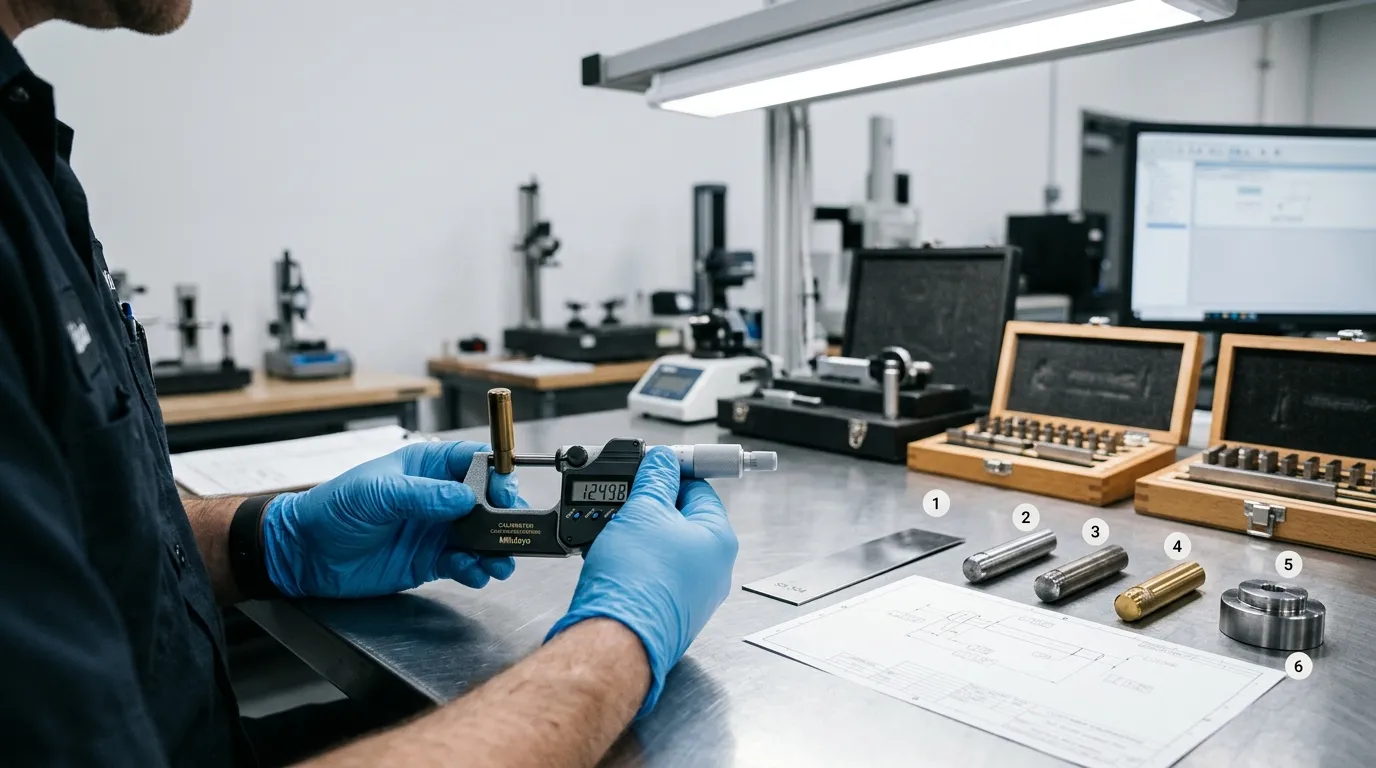
A supplier cannot make a defensible recommendation from the phrase “punch for stainless steel” alone.
Include the following information in the request:
- stainless grade and family;
- ketebalan lembaran;
- temper, kekerasan, or tensile condition;
- part and hole drawing;
- punch diameter, panjang, kepala, batang, and corner geometry;
- required dimensional tolerances;
- die clearance where known;
- press type and stroke rate;
- volume produksi yang diharapkan;
- target service interval;
- lubricant or dry-running restriction;
- current punch material and hardness;
- current coating or treatment;
- photographs or samples of wear, pengambilan, mengelupas, or breakage;
- regrinding and recoating expectations;
- bahan yang dibutuhkan, kekerasan, berdimensi, atau dokumentasi pelapisan.
SunshinePro states that it supplies standard components and non-standard customized parts processed from customer drawings. Its relevant punch pages list combinations of CNC machining, penggilingan presisi, EDM, perlakuan panas vakum, dimensi khusus, HSS, karbida, stainless tool steel, dan opsi pelapisan terpilih.
These website-confirmed capabilities should still be reviewed against the actual drawing and application. A tolerance or material listed on one product page should not be assumed to apply to every punch geometry.
Prinsip Seleksi Akhir
Use this order when selecting punch pins for stainless steel stamping:
- Identify the stainless grade, kondisi, ketebalan, and feature geometry.
- Determine whether the current failure is galling, keausan abrasif, mengelupas, kerusakan, atau deformasi.
- Correct alignment, pembersihan, panduan, menyelesaikan, mengupas, and lubrication problems.
- Select the substrate for bulk toughness, kekuatan tekan, and edge stability.
- Select the coating or treatment for the dominant surface failure.
- Compare serviceability, waktu istirahat, and cost per hit.
- Confirm the final system through drawing review and application-specific validation.
For a custom review, mengajukan gambar, stainless specification, kondisi produksi, and current failure details through SunshinePro’s Halaman kontak. That information gives the supplier a practical basis for evaluating the punch material, perlakuan panas, menyelesaikan, pelapisan, dan persyaratan inspeksi.
Bagikan:


Ditulis oleh Sunshine
di Sunshine, Kami adalah produsen dan pemasok profesional komponen cetakan presisi, menawarkan berbagai produk untuk aplikasi stamping dan cetakan injeksi. Fokus utama kami adalah mencetak cetakan, pin dan lengan ejector, serta tiang panduan dan bushing. Dengan pemesinan CNC canggih, kontrol kualitas ketat, dan kemampuan produksi yang kuat, kami memastikan keandalan, suku cadang presisi tinggi, bersama dengan komponen standar yang tersedia untuk pasokan global yang cepat dan efisien.
BERITA
DAPATKAN LAYANAN
Dengan suku cadang berkualitas untuk memenuhi setiap anggaran dan staf ramah yang terlatih untuk membuat kunjungan Anda menjadi informatif dan tanpa repot.
