



Suku Cadang Cetakan Presisi: Toleransi, Baja, Selesai, dan Daftar Periksa QC
Precision mold parts must balance tolerance capability, kelas baja, finishing permukaan, and inspection quality to maintain stable injection molding performance. Buyers should compare suppliers using measurable QC processes, keterlacakan material, dimensional inspection methods, and realistic lead-time expectations instead of relying only on low pricing or “high precision” marketing claims.
A mold can look well-machined and still fail during production because of poor tolerance control, incorrect steel selection, or weak inspection procedures. Small dimensional problems often create flash, part sticking, inconsistent shrinkage, or early wear. This guide explains how engineers and buyers can compare precision mold parts using practical standards instead of supplier claims alone.
What are precision mold parts and why do they matter in injection molding?
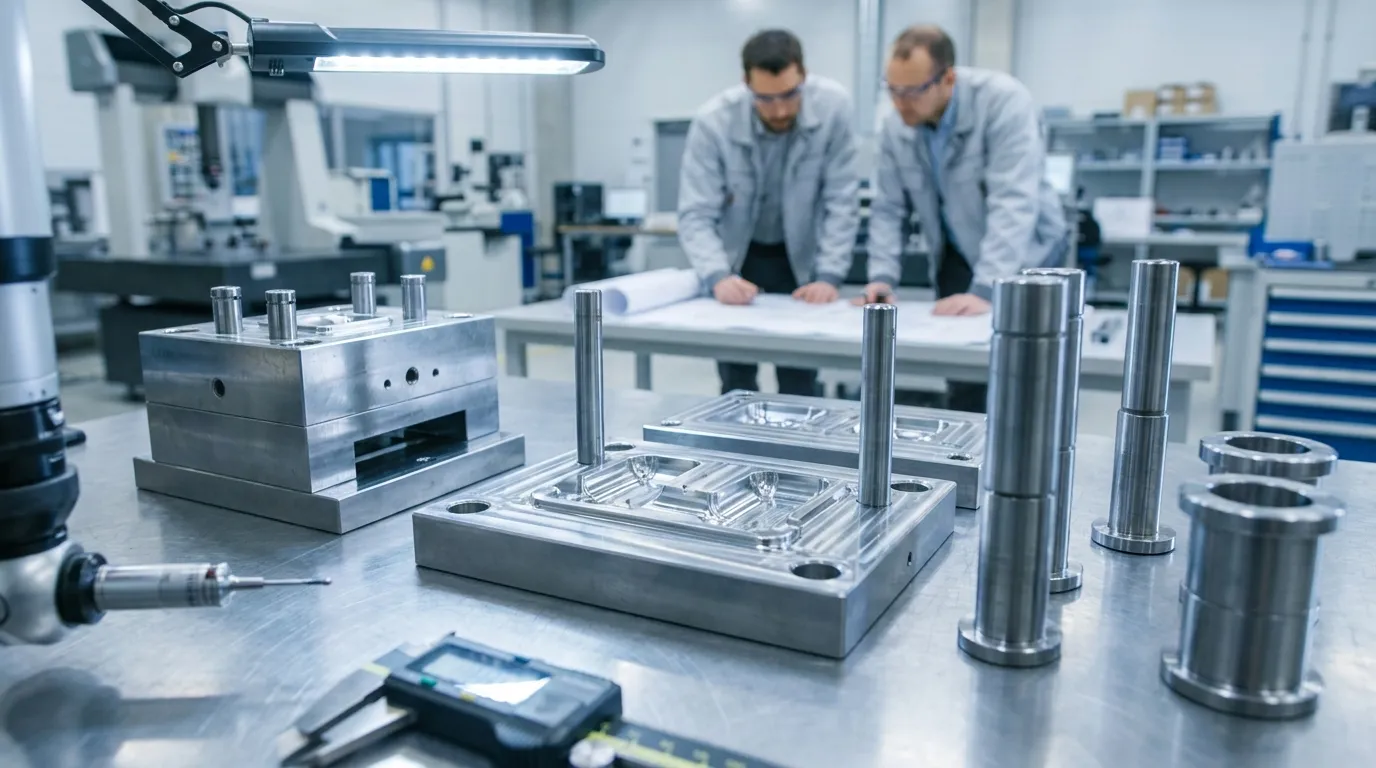
Precision mold parts are high-accuracy mold components such as cores, rongga, Ejector, and inserts manufactured to tight tolerances. Their dimensional consistency directly affects molded part accuracy, stabilitas siklus, ketahanan aus, and long-term production reliability.
Precision mold parts are the components inside a mold that directly control part geometry, movement, dan penyelarasan. These parts include mold inserts, penggeser, pin ejector, busing panduan, Warna, dan rongga. Even small dimensional errors can affect the molded product after thousands of production cycles.
Misalnya, a cavity insert with slight dimensional drift may create flash on a medical housing or cause uneven shrinkage in a packaging component. That problem usually becomes more expensive after production begins because downtime, pengolahan ulang, and scrap costs increase quickly.
Banyak pembeli memulai dengan luas Panduan Komponen Cetakan to understand how mold systems work together before comparing individual precision components.
| Komponen Presisi | Fungsi utama | Risiko jika Toleransi Gagal |
|---|---|---|
| Sisipan inti | Membentuk geometri internal | Ketidakcocokan dimensi |
| Sisipan rongga | Bentuk bentuk eksternal | Cacat kilat atau kosmetik |
| Pin ejektor | Menghapus bagian yang dicetak | Tanda menempel atau pin |
| Panduan bushing | Mempertahankan keselarasan | Keausan dan ketidakstabilan jamur |
| Penggeser | Membuat fitur samping | Kebocoran atau deformasi bagian |
Pembeli membandingkan Ikhtisar Bagian Cetakan Plastik pages should focus less on catalog variety and more on measurable process capability, inspection control, and steel traceability.
What tolerance range is realistic for precision mold parts?
Precision mold parts commonly operate within micron-level tolerances, but tighter specifications increase machining, inspeksi, and rejection costs. Not every mold component requires ultra-tight control, so tolerance should match the molding function and production risk.
Many suppliers advertise “high precision” without defining actual tolerance capability. Dalam praktiknya, required tolerance depends on the component’s role inside the mold. A cavity insert handling cosmetic alignment needs tighter control than a support plate or non-critical mounting feature.
Ultra-tight tolerance is not always the best choice. Some mold components perform reliably with wider tolerances that reduce machining cost and inspection delays. Over-specifying every dimension often increases lead time without improving molding results.
Which mold components require the tightest tolerances?
Critical sealing surfaces, shut-off areas, cavity inserts, and alignment components usually require the highest precision. These areas directly affect molded part quality and mold movement.
Support structures and non-contact surfaces often allow wider tolerances without affecting production stability.
| Jenis Komponen | Persyaratan Presisi Khas | Mengapa Itu Penting |
|---|---|---|
| Sisipan rongga | Very high | Mengontrol dimensi cetakan |
| Permukaan penutup | Very high | Mencegah lampu kilat |
| Komponen panduan | Tinggi | Mempertahankan keselarasan |
| Sistem ejektor | Sedang | Mendukung pelepasan yang mulus |
| Pelat pendukung | Lebih rendah | Dampak cetakan terbatas |
A packaging mold project may require tight cavity tolerance control to prevent flash around thin walls, while surrounding support plates can use wider tolerance ranges. One buyer reduced machining cost significantly after relaxing unnecessary tolerances on non-critical support components.
Insinyur membandingkan Komponen cetakan presisi should ask suppliers which dimensions receive full inspection instead of assuming every surface receives the same level of control.
Which steel grade should buyers choose for precision mold parts?
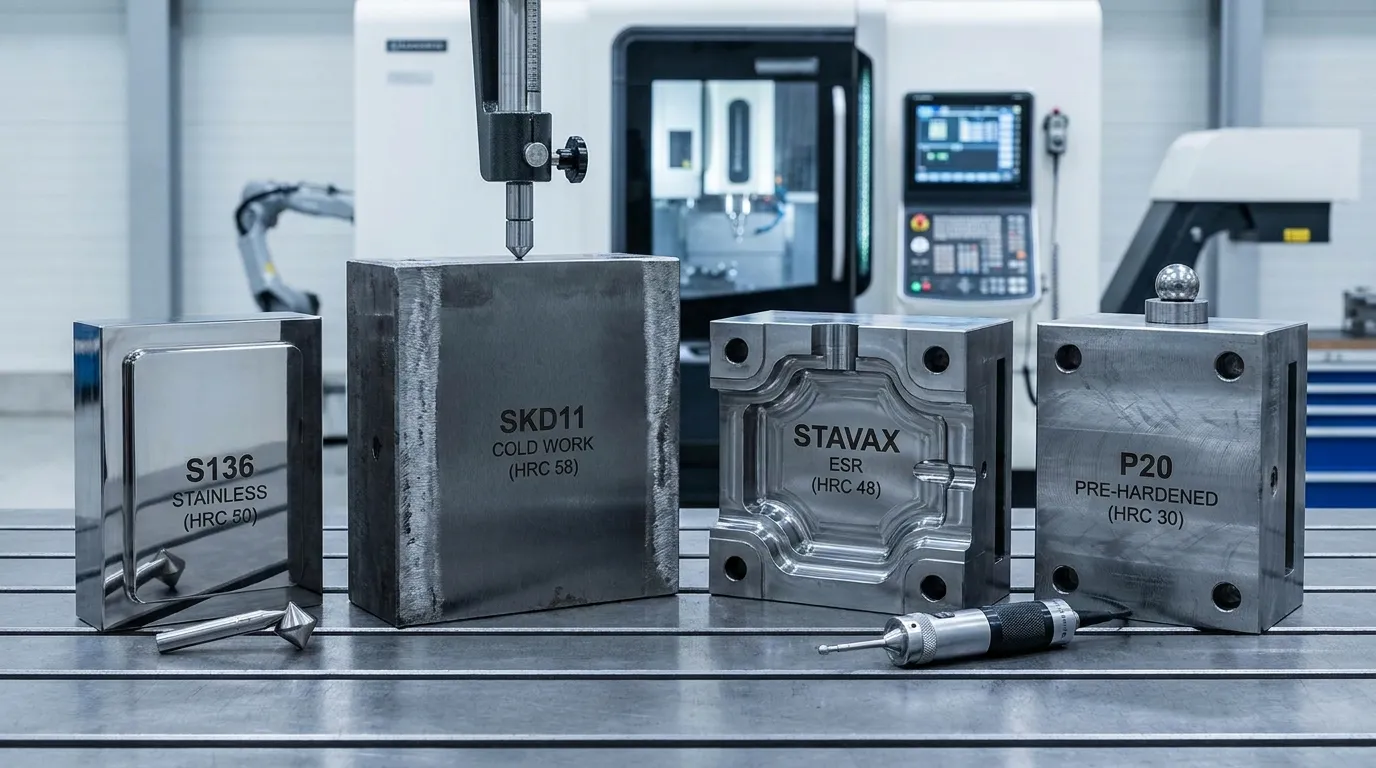
Mold steel selection depends on production volume, tipe resin, paparan korosi, dan kondisi keausan. Harder steel is not automatically better because machining difficulty, brittleness, polishability, and maintenance requirements also affect long-term tooling performance.
Steel selection changes mold lifespan, polish quality, interval pemeliharaan, and repair difficulty. Buyers often compare popular grades like S136, SKD11, STAVAX, and P20, but the best option depends on production conditions rather than brand familiarity alone.
Harder mold steel is not automatically better. Extremely hard steel can increase brittleness, polishing difficulty, and repair complexity in high-maintenance molds. Some high-volume molds actually perform better with balanced hardness and easier maintenance access.
When is stainless mold steel worth the added cost?
Stainless grades such as S136 or STAVAX work well in corrosive environments, medical molding, and humid production conditions. They also support polished cosmetic surfaces more effectively than some general-purpose steels.
A medical mold insert exposed to moisture and aggressive cleaning chemicals may fail early with standard tool steel. Stainless mold steel often prevents corrosion damage and extends maintenance intervals in those environments.
Meja Pemilihan Baja Cetakan Presisi
| Kelas Baja | Keuntungan utama | Kasus Penggunaan Terbaik | Ketahanan Aus Relatif | Catatan Pemeliharaan |
|---|---|---|---|---|
| Hal. 20 | Pemesinan mudah | Cetakan produksi umum | Sedang | Lebih mudah diperbaiki |
| SKD11 | Ketahanan aus yang kuat | Aplikasi resin abrasif | Tinggi | Pemolesan yang lebih keras |
| S136 | Ketahanan korosi | Cetakan medis dan kosmetik | Tinggi | Baik untuk hasil akhir yang dipoles |
| STAVAX | Kemampuan pemolesan tinggi | Bagian optik atau transparan | Tinggi | Biaya material yang lebih tinggi |
Banyak pembeli yang meneliti bahan komponen cetakan focus only on hardness values. Ketahanan aus, paparan korosi, persyaratan Polandia, and repair access usually matter just as much during long production runs.
How does surface finish affect mold performance and part quality?
Surface finish affects part appearance, release behavior, ketahanan aus, and cleaning requirements. A mirror finish improves cosmetic clarity for some applications, but many industrial molds perform better with practical finishes that reduce maintenance and machining cost.
Surface finish changes more than appearance. It affects mold release, gesekan, cleaning cycles, resin flow, dan perilaku aus. Cosmetic consumer products often require polished cavity surfaces, while industrial parts may perform better with controlled texture or practical machining finishes.
Mirror-polished surfaces are often overused. Many industrial molding applications achieve better long-term performance with practical finishes that reduce maintenance and tooling cost. Highly polished surfaces can increase polishing time and future repair expense without improving the molded part.
| Jenis Selesai | Penggunaan umum | Manfaat Utama |
|---|---|---|
| Semir cermin | Bagian optik atau kosmetik | Kejernihan visual yang tinggi |
| Semir halus | Produk konsumen | Penampilan seimbang |
| Tekstur EDM | Komponen industri | Cengkeraman dan pelepasan yang lebih baik |
| Selesai mesin | Area perkakas fungsional | Biaya perawatan yang lebih rendah |
A cosmetic electronics housing may require mirror-polished cavity surfaces for visual clarity. A structural industrial part usually benefits more from stable release performance and lower maintenance requirements.
Pembeli mengulas komponen cetakan injeksi should match finish quality to actual product requirements instead of automatically choosing the highest polish level.
How are precision mold parts inspected before approval?
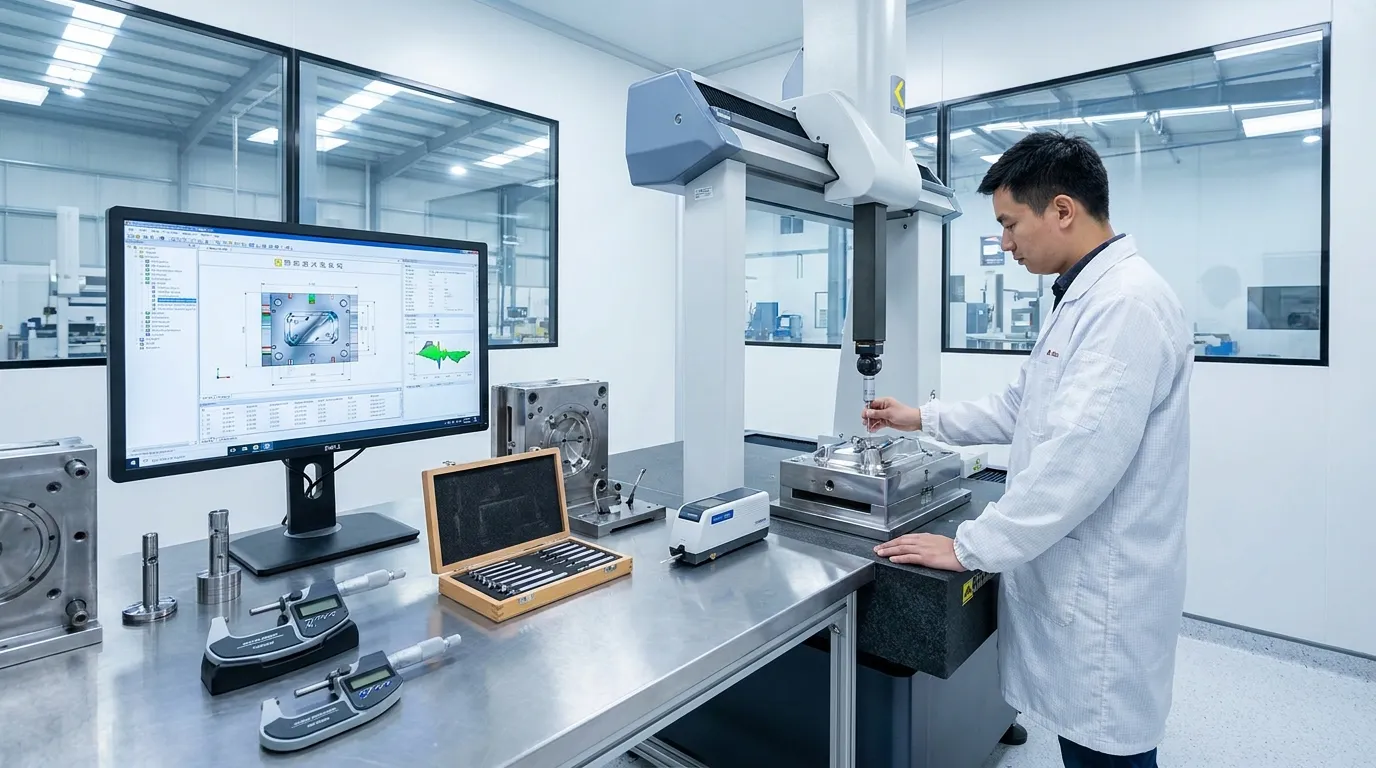
Precision mold part inspection should combine dimensional measurement, verifikasi kekerasan, surface evaluation, and documented first article approval. Buyers should request measurable inspection data instead of relying only on supplier claims about precision capability.
A reliable inspection process starts before shipment. Suppliers should verify dimensions against engineering drawings, confirm material specifications, inspect surface finish quality, and document all critical measurements.
Many procurement teams reject suppliers because inspection reports lack measurable traceability. If a supplier cannot explain how dimensions were verified, future production consistency becomes difficult to trust.
Which inspection tools matter most?
Coordinate Measuring Machines (CMMs) remain one of the most important inspection tools for complex mold geometry. Micrometers, hardness testers, pin gauges, and surface roughness instruments also support dimensional verification.
| Alat Inspeksi | Tujuan utama |
|---|---|
| CMM | Pengukuran dimensi kompleks |
| Mikrometer | Pengukuran presisi eksternal |
| Pengukur pin | Verifikasi lubang |
| Penguji kekerasan | Validasi kekerasan baja |
| Penguji kekasaran permukaan | Selesaikan pemeriksaan kualitas |
A supplier should also provide first article inspection records before approval. This documentation helps buyers compare measured dimensions against the original drawing package.
Daftar Periksa Persetujuan QC Bagian Cetakan
- Verifikasi revisi gambar teknik
- Konfirmasi sertifikasi material
- Tinjau catatan pengujian kekerasan
- Memeriksa dimensi penting menggunakan laporan CMM
- Periksa kualitas permukaan akhir
- Konfirmasikan permukaan penutupan dan penyegelan
- Memverifikasi dokumentasi ketertelusuran
- Tinjau metode perlindungan pengemasan
- Konfirmasikan akurasi pelabelan pengiriman
- Menyetujui laporan inspeksi artikel pertama
International trade documentation also affects approval timing. Itu AS. International Trade Administration notes that incomplete compliance records can disrupt import timelines, especially for industrial manufacturing shipments.
Pembeli mengevaluasi pemasok Proses Inspeksi Presisi should verify how inspection data is stored, reviewed, and linked to each production batch.
What causes delays in precision mold part delivery?
Precision mold part delays often result from incomplete drawings, inspection failures, customs documentation errors, tariff classification problems, dan revisi desain tahap akhir. Many delays occur after machining is complete rather than during manufacturing itself.
Machining is only one part of the delivery timeline. Inspection rework, engineering revisions, customs holds, and shipment paperwork often create larger delays than the machining process itself.
One tooling project experienced shipment delays because HS code classification errors triggered customs inspection holds during export processing. The shipment was already complete, but documentation problems delayed delivery for days.
| Sumber Penundaan | Kemungkinan Hasil | Metode Pencegahan |
|---|---|---|
| Gambar tidak lengkap | Pengerjaan ulang pemesinan | Persetujuan pengundian akhir |
| Inspeksi gagal | Penundaan produksi | Pemeriksaan QC menengah |
| Kesalahan kode HS | Penahanan bea cukai | Klasifikasi terverifikasi |
| Revisi desain | Perpanjangan waktu tunggu | Mengubah proses kontrol |
| Kelebihan pemasok | Jadwalkan selip | Verifikasi kapasitas |
Itu AS. Bea Cukai dan Perlindungan Perbatasan highlights that incorrect customs documentation can increase inspection and clearance delays. Tariff uncertainty also affects sourcing timelines and budgeting decisions in global tooling programs.
How should buyers compare precision mold part suppliers?
Buyers should compare mold suppliers based on measurable inspection capability, documentation quality, steel traceability, kontrol proses, and communication responsiveness rather than price alone. Low-cost precision parts can become expensive if dimensional drift causes production downtime.
A low quote does not always mean lower total cost. Poor inspection control, weak communication, or inconsistent machining quality can create expensive production interruptions later.
Procurement teams should compare suppliers using measurable criteria instead of marketing claims. A supplier that documents inspection capability clearly is usually easier to manage during production changes or troubleshooting.
Bendera merah selama evaluasi pemasok
The biggest warning sign is vague technical communication. If a supplier cannot explain tolerance verification, inspection frequency, or steel sourcing clearly, future QC problems become more likely.
- Ketertelusuran material yang hilang
- Laporan inspeksi umum
- Waktu tunggu yang tidak realistis
- Dukungan teknik terbatas
- Kontrol revisi yang buruk
Daftar Periksa Perbandingan Pembeli
| Area Evaluasi | Apa yang Harus Pembeli Verifikasi |
|---|---|
| Kemampuan inspeksi | Akses dan pelaporan CMM |
| Kontrol material | Catatan ketertelusuran baja |
| Komunikasi | Kecepatan respons teknik |
| Stabilitas proses | Metode pemesinan yang dapat diulang |
| Keandalan pengiriman | Penjadwalan produksi yang realistis |
| Dokumentasi | Laporan yang dikendalikan revisi |
A buyer once rejected a supplier after discovering the inspection report contained no CMM traceability and no measurement references tied to the engineering drawing. That issue appeared before production began, which prevented larger quality problems later.
Tim yang meneliti Kemampuan Pemasok Cetakan should compare process transparency as carefully as pricing.
Daftar periksa QC suku cadang cetakan presisi sebelum persetujuan akhir
Before approving shipment, buyers should confirm that every critical dimension matches the latest engineering drawing revision. Sertifikasi material, hardness testing, and traceability records should also align with purchase specifications.
Daftar Periksa Persetujuan Akhir
- Mengonfirmasi revisi gambar yang disetujui
- Cocokkan kelas baja dengan pesanan pembelian
- Verifikasi nilai uji kekerasan
- Tinjau laporan inspeksi CMM
- Periksa permukaan penutup kritis
- Periksa konsistensi permukaan akhir
- Konfirmasikan keselarasan rongga dan inti
- Verifikasi perlindungan kemasan
- Konfirmasi label dan dokumentasi pengiriman
- Arsipkan catatan inspeksi untuk pemeliharaan di masa mendatang
Banyak produsen juga mempertahankan Panduan cetakan injeksi plastik internally to standardize sourcing, tooling approval, and long-term maintenance procedures across multiple projects.
Mendapatkan Langkah Selanjutnya dengan Benar
Choosing precision mold parts is less about finding the cheapest supplier and more about reducing long-term production risk. Kemampuan toleransi, seleksi baja, surface finish quality, and inspection discipline all affect mold stability after production begins.
Sebelum menyetujui pemasok, review inspection documentation carefully, compare material traceability, and verify how dimensional control is managed during machining. A supplier with clear QC procedures and realistic lead times usually delivers more stable production performance than one focused only on aggressive pricing.
Pertanyaan yang Sering Diajukan
What are precision mold parts?
Precision mold parts are high-accuracy mold components manufactured to tight dimensional tolerances for injection molding systems. Common examples include mold cores, rongga, sisipan, pin ejector, penggeser, and bushings that directly affect molded part quality and production stability.
What tolerance can precision mold parts achieve?
Precision mold parts can achieve micron-level tolerances depending on geometry, material, and machining method. Tighter tolerances increase manufacturing cost, inspection complexity, and rejection risk, so specifications should match actual molding requirements.
Which steel is best for precision mold parts?
The best mold steel depends on wear conditions, tipe resin, paparan korosi, dan volume produksi. Grade stainless seperti S136 meningkatkan ketahanan korosi, while hardened tool steels such as SKD11 provide strong wear resistance for demanding applications.
Bagaimana bagian cetakan presisi diperiksa?
Precision mold parts are typically inspected using CMM systems, mikrometer, hardness testing, surface finish measurement, and dimensional comparison against engineering drawings. Buyers should request inspection reports and first article documentation before approval.
What causes delays in mold component shipments?
Mold component shipments are commonly delayed by incomplete customs documentation, tariff classification errors, inspeksi yang gagal, late engineering revisions, and supplier scheduling bottlenecks. Inspection rework can also extend lead times significantly.
How long do precision mold parts take to manufacture?
Precision mold part lead times vary by complexity, tolerance level, kelas baja, dan persyaratan inspeksi. Standard components may ship within days, while custom high-precision parts can require several weeks including inspection and validation.
Bagikan:


Ditulis oleh Sunshine
di Sunshine, Kami adalah produsen dan pemasok profesional komponen cetakan presisi, menawarkan berbagai produk untuk aplikasi stamping dan cetakan injeksi. Fokus utama kami adalah mencetak cetakan, pin dan lengan ejector, serta tiang panduan dan bushing. Dengan pemesinan CNC canggih, kontrol kualitas ketat, dan kemampuan produksi yang kuat, kami memastikan keandalan, suku cadang presisi tinggi, bersama dengan komponen standar yang tersedia untuk pasokan global yang cepat dan efisien.
BERITA
DAPATKAN LAYANAN
Dengan suku cadang berkualitas untuk memenuhi setiap anggaran dan staf ramah yang terlatih untuk membuat kunjungan Anda menjadi informatif dan tanpa repot.
