



Komponen Presisi untuk Cetakan: Ketika Akurasi dan Ketahanan Aus Penting
Precision components for molds are high-tolerance parts that improve alignment, keterulangan, and wear resistance in injection mold systems. Components such as guide posts, pin ejector, and bushings need tight dimensional control to reduce flash, uneven wear, and part variation. The right material, pelapisan, and inspection process can extend mold life and maintain stable production quality across long manufacturing runs.
A mold can look well-built on paper and still fail in production because of small component inaccuracies. Ketidaksejajaran, keausan permukaan, and tolerance drift often start with the parts that guide, posisi, and eject material inside the mold. For manufacturers running high-volume production, precision components are not just about tighter machining. They affect maintenance costs, scrap rates, and long-term mold stability.
What are precision components in mold manufacturing?
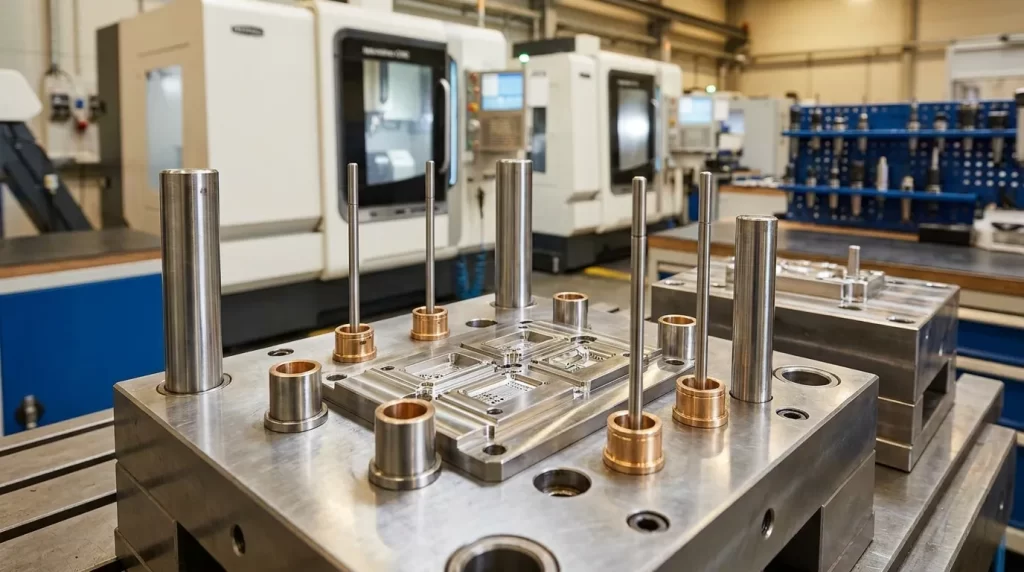
Precision components in molds are high-tolerance parts designed to maintain alignment, keterulangan, and dimensional accuracy during repeated production cycles. They reduce variation, minimize wear-related defects, and improve mold lifespan.
Dalam pembuatan cetakan, precision components refer to parts that must maintain exact positioning under repeated mechanical stress. These components include guide posts, bushing, pin ejector, sleeves, and cavity inserts. Even a small dimensional shift can create flash, menempel, or inconsistent plastic parts.
The need for precision becomes more obvious in high-cycle molds. A mold producing thousands of parts each day cannot rely on loose-fitting components. Wear increases quickly when alignment drifts, especially in molds processing abrasive resins or thin-wall parts.
Manufacturers often use hardened tool steels, penggilingan presisi, Pemesinan EDM, and advanced inspection systems to maintain dimensional consistency. A broader overview of mold systems and component categories is available in this Panduan Komponen Cetakan Lengkap.
For buyers comparing suppliers, the key issue is not just machining capability. It is whether the supplier can maintain repeatability over long production runs using properly engineered Komponen cetakan presisi.
Which mold components require the highest precision?
Sistem panduan, ejector components, and cavity alignment parts usually require the highest precision because even small dimensional variation can create flash, mismatch, keausan dini, or unstable part quality.
Not every mold component needs micron-level tolerances. Some areas are far more sensitive to dimensional variation than others. Guide systems and moving parts usually experience the highest stress and alignment pressure during production.
Sistem panduan
Guide posts and bushings control mold alignment during opening and closing. If these parts wear unevenly, cavity surfaces may no longer match correctly. That often causes flash on finished parts or visible mismatch lines.
Automotive trim molds are a common example. A guide-post tolerance difference as small as ±0.01 mm can affect visible surface quality on exterior plastic parts.
Sistem ejektor
Ejector pins and sleeves require smooth movement and consistent positioning. Excess friction or slight misalignment increases wear and can damage molded parts during ejection.
In high-volume electronics production, ejector pins often fail early because of short cycle times and repeated friction contact. Poor alignment accelerates galling and surface scoring.
| Komponen Cetakan | Mengapa Presisi Penting | Risiko Kegagalan Umum |
|---|---|---|
| Pos panduan | Mempertahankan keselarasan cetakan | Flash dan ketidakcocokan |
| Bushing | Mengontrol stabilitas gerakan | Keausan yang tidak merata |
| Pin ejektor | Mendukung pelepasan bagian bersih | Pin menempel |
| Sisipan inti | Mempertahankan akurasi dimensi | Inkonsistensi bagian |
| Lengan | Mengurangi gerakan gesekan | Penilaian permukaan |
Sumber produsen bagian penyelarasan cetakan should focus on repeatability and wear performance instead of chasing the tightest possible tolerance everywhere.
What tolerance range is considered high precision for mold components?
High-precision mold components commonly operate within ±0.01 mm tolerance or tighter depending on mold complexity, tipe resin, and production volume requirements.
Tolerance requirements depend on the mold application. Thin-wall packaging molds and medical molds usually require tighter dimensional control than general consumer products. Menurut Attur Internasional, precision machining applications often operate within ±0.01 mm tolerance ranges.
That does not mean every component should be machined to the tightest possible limit. Ultra-tight tolerances are not automatically better. If the mold application does not require them, they can increase cost without improving production stability.
| Jenis Aplikasi | Persyaratan Toleransi Khas |
|---|---|
| Komponen cetakan umum | ±0.02 mm |
| Bagian penyelarasan presisi | ±0.01 mm |
| Cetakan dinding tipis | ±0.005 mm |
| Cetakan medis atau mikro | Below ±0.005 mm |
Tolerance planning should match actual production conditions. High-volume molds processing abrasive materials usually benefit more from stable wear resistance than from unnecessary ultra-fine tolerances.
Why does wear resistance matter in injection molds?
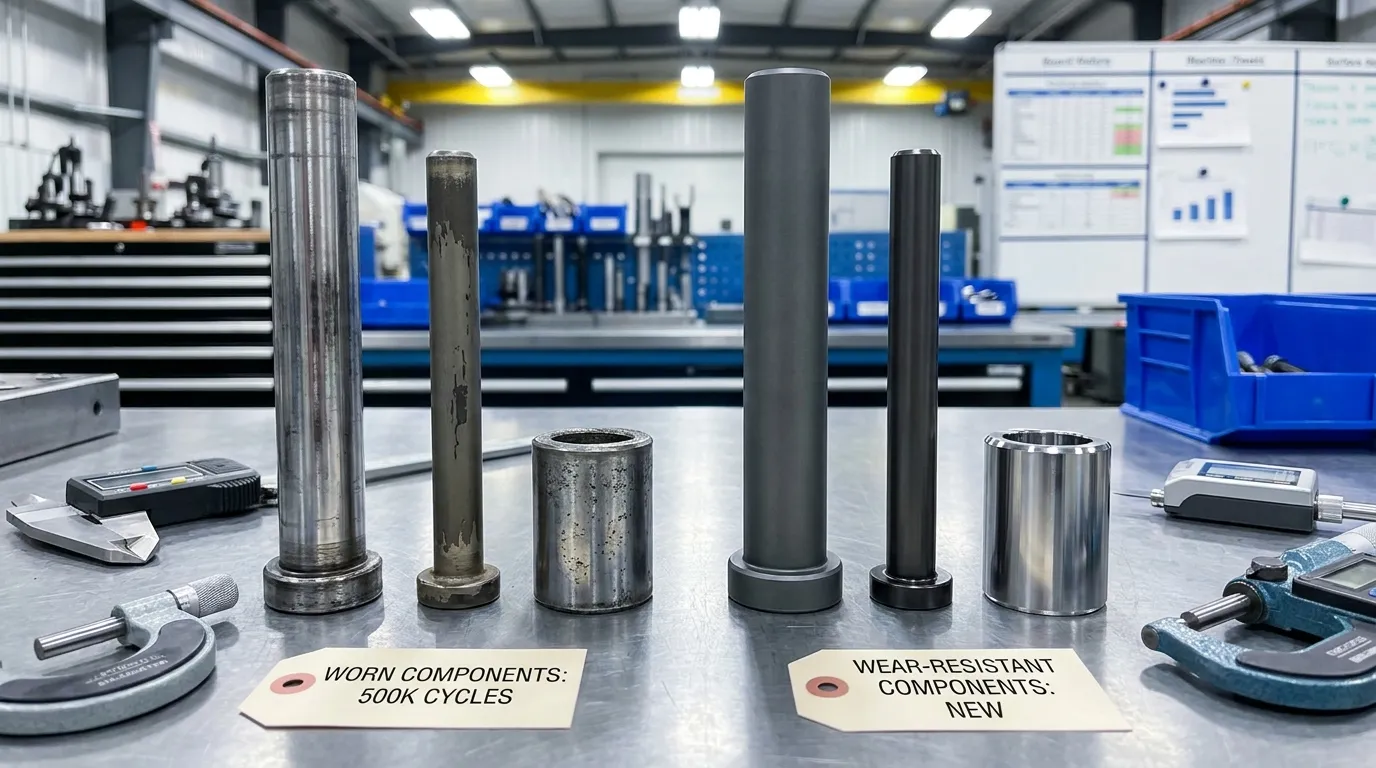
Wear resistance directly affects mold lifespan, stabilitas siklus, dan konsistensi bagian. Poor wear performance increases maintenance frequency, pergeseran dimensi, and the risk of flash or sticking during production.
Mold components experience repeated friction, tekanan, and heat during production. Seiring waktu, these forces remove material from contact surfaces and reduce alignment accuracy. Once wear begins, dimensional variation spreads quickly through the entire mold system.
Abrasive plastics make the problem worse. Glass-filled resins and engineering plastics create higher friction loads that accelerate surface damage. Components that start with weak hardness or poor surface treatment often fail much earlier than expected.
Titik keausan umum
The most common wear locations include:
- Tiang pemandu dan bushing
- Pin ejektor
- Inti geser
- Permukaan penutup
- Lengan dan sisipan bergerak
Coatings help, but they cannot compensate for poor alignment or weak base material selection. A nitrided surface on a poorly fitted guide system will still wear unevenly under repeated load.
Daftar Periksa Kegagalan Keausan Cetakan
| Tanda Peringatan | Kemungkinan Penyebab | Tindakan yang Direkomendasikan |
|---|---|---|
| Flash pada bagian yang dicetak | Keausan penyelarasan | Periksa sistem panduan |
| Pin menempel | Permukaan galling | Ganti atau lapisi pin ejektor |
| Keausan rongga tidak merata | Kekerasan yang buruk | Tingkatkan kelas material |
| Penilaian permukaan | Kerusakan gesekan | Meningkatkan pelumasan |
| Perawatan yang sering | Ketahanan aus lemah | Tinjau strategi pelapisan |
Untuk produsen yang membandingkan bagian cetakan tahan aus, the better long-term choice is often the component that reduces downtime rather than the one with the lowest purchase price.
Which materials and coatings improve mold component lifespan?
High-grade tool steels combined with surface treatments like nitriding or PVD coatings improve hardness, mengurangi gesekan, and extend the operating life of precision mold components under repeated production stress.
Material selection affects both wear resistance and dimensional stability. Hardened tool steels are common because they maintain strength under repeated mechanical load. Surface treatments improve resistance to friction and abrasion without changing the entire component structure.
Nitriding is widely used because it hardens the outer surface while maintaining core toughness. PVD coatings reduce friction and improve release performance on moving parts.
| Bahan atau Pelapisan | Manfaat Utama | Penggunaan Khas |
|---|---|---|
| Baja perkakas | Kekerasan tinggi | Komponen inti |
| Nitridasi | Ketahanan aus permukaan | Sistem panduan |
| Lapisan PVD | Gesekan yang lebih rendah | Pin ejektor |
| Perlakuan panas | Stabilitas dimensi | Bagian struktural |
A supplier comparison often shows the real value of coatings. One production facility using coated bushings reduced maintenance intervals compared with untreated steel bushings operating under the same cycle conditions.
Custom precision components are valuable for high-cycle or complex molds, but standard parts are often the smarter choice for easier maintenance and replacement. Buyers evaluating Komponen cetakan tahan lama should balance lifespan, replacement speed, and total operating cost.
How are precision mold components inspected and verified?
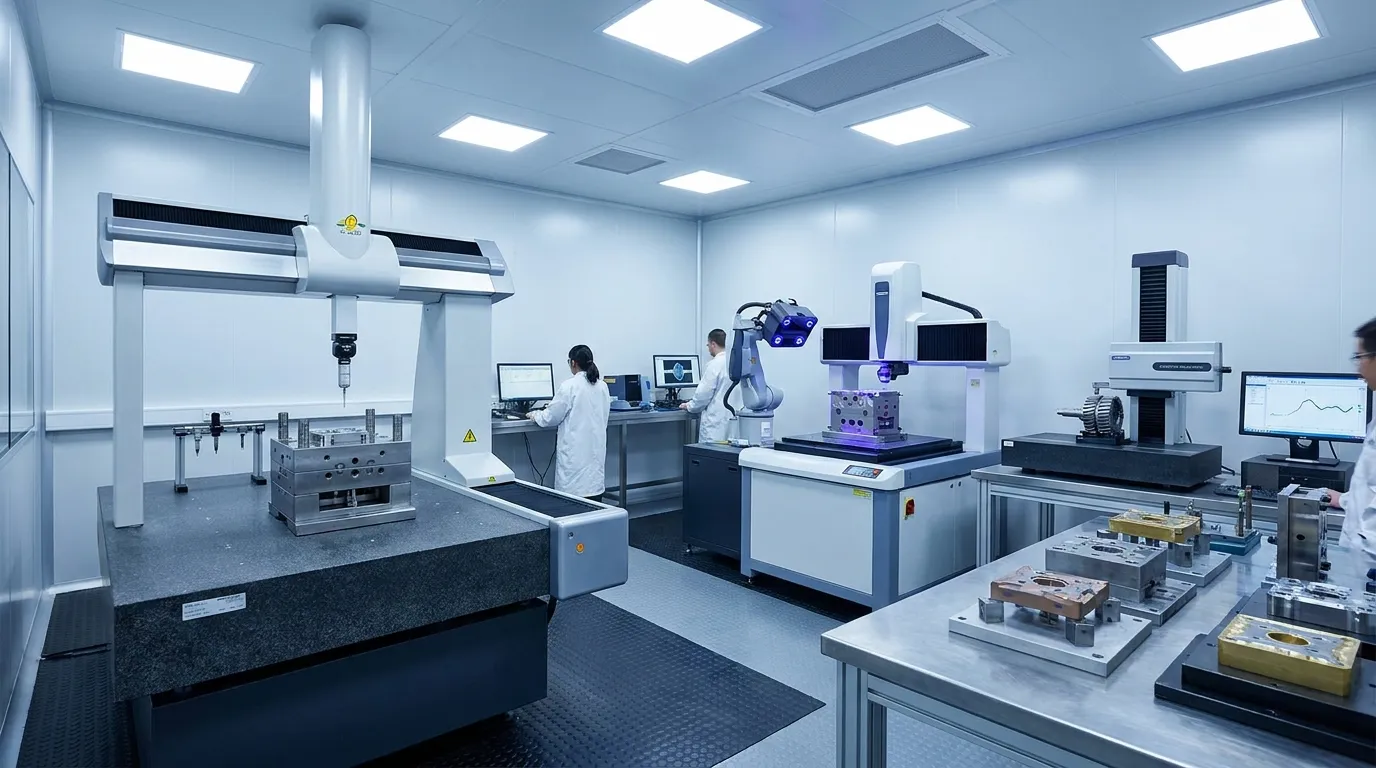
Manufacturers verify precision mold components using contour measurement systems, optical inspection, and dimensional metrology tools to confirm tolerance accuracy and surface conformity before production use.
Inspection matters because even small dimensional variation can affect mold performance. Most suppliers use multiple verification methods depending on component complexity and tolerance requirements.
Menurut MinebeaMitsumi, precision manufacturing depends heavily on dimensional consistency and stable machining accuracy.
Proses inspeksi khas
- Pengukuran dimensi awal menggunakan kaliper atau mikrometer
- Verifikasi presisi dengan CMM atau sistem pengukuran kontur
- Inspeksi permukaan untuk bekas keausan atau cacat akhir
- Validasi pengulangan akhir sebelum pengiriman
Optical inspection systems are common for smaller components with complex geometry. Contour measuring equipment helps verify profiles and edge accuracy on inserts and precision-fit parts.
Inspection also helps identify process drift before it becomes a production issue. In thin-wall molding, a ±0.01 mm alignment variation can create inconsistent cavity fill and visible defects across thousands of parts.
Are custom precision components always better than standard parts?
Custom precision components are not always the best choice. They work well for demanding molds with tight tolerances or unusual geometry, but standard components are often easier to replace and maintain during regular production.
The decision depends on production volume, kompleksitas, dan strategi pemeliharaan. A custom component may improve cycle stability in a high-volume automotive mold, but it can also increase lead time and replacement cost.
Tabel Keputusan Presisi vs Komponen Standar
| Situasi | Pilihan yang Lebih Baik | Mengapa |
|---|---|---|
| Produksi volume tinggi | Suku cadang presisi khusus | Stabilitas jangka panjang yang lebih baik |
| Produk konsumen sederhana | Suku cadang standar | Penggantian lebih cepat |
| Cetakan toleransi yang ketat | Bagian khusus | Penyelarasan yang ditingkatkan |
| Lingkungan perawatan yang sering | Suku cadang standar | Sumber yang lebih mudah |
| Geometri cetakan yang kompleks | Bagian khusus | Kesesuaian dan kinerja yang lebih baik |
A buyer producing low-volume consumer products may gain little value from expensive custom alignment systems. Dilain pihak, medical or electronics molds often justify higher precision because downtime and defect rates carry much higher production costs.
The smarter approach is matching component strategy to production conditions instead of assuming tighter tolerance always improves results.
How do sourcing and customs delays affect precision component supply?
Precision mold components often have longer sourcing timelines because they require specialized machining, inspeksi, and export documentation. Customs delays can add another layer of risk when replacement parts are needed quickly.
Shipment documentation matters more in 2026 because import systems are stricter in several regions. The EU’s Import Control System 2 (ICS2) requires more detailed shipment information for imported goods.
A common problem is vague shipment labeling. One supplier described mold components simply as “machine parts,” which delayed customs clearance because the classification lacked enough detail.
Daftar Periksa Pengiriman Komponen Presisi
- Konfirmasikan akurasi kode HS sebelum pengiriman
- Gunakan deskripsi bagian terperinci
- Verifikasi dokumentasi material
- Sertakan spesifikasi dimensi bila diperlukan
- Mengonfirmasi persyaratan kepatuhan tujuan
- Tinjau dokumen impor sebelum pengiriman
Menurut Panduan DHL tentang penundaan bea cukai dan baru-baru ini Buletin perdagangan CBP, incomplete documentation remains a major cause of shipping disruption.
Apa yang Harus Dilakukan Selanjutnya
Choosing the right precision components comes down to production stability, ketahanan aus, and realistic tolerance requirements. The best option is not always the tightest or most expensive part. It is the component that maintains accuracy over time without creating unnecessary maintenance cost or sourcing delays.
If you are reviewing mold performance problems, start with alignment systems, ejector components, and wear surfaces first. Those areas usually reveal the earliest signs of dimensional drift. For a broader understanding of mold systems and applications, ini Panduan cetakan injeksi plastik provides additional context on how molds are designed and used across production environments.
Pertanyaan yang Sering Diajukan
What are precision components used for in molds?
Precision components maintain alignment, akurasi dimensi, and repeatability inside mold systems. They help reduce defects, improve consistency, and extend mold lifespan during repeated production cycles.
What tolerance is considered high precision in mold manufacturing?
High precision in mold manufacturing commonly means tolerances around ±0.01 mm or tighter depending on the application. Critical mold areas may require even smaller variation for stable production.
Which mold components wear out the fastest?
Pin ejektor, guide systems, and high-friction contact surfaces usually experience the fastest wear. Pelumasan yang buruk, ketidaksejajaran, and abrasive materials accelerate failure.
Are coated mold components worth the cost?
Coated components often last longer and reduce friction in high-cycle production environments. The added cost is usually justified when downtime or replacement frequency becomes expensive.
How are precision mold parts inspected?
Manufacturers use contour measuring systems, optical inspection equipment, and dimensional metrology tools to verify tolerances and surface quality. Inspection confirms repeatability before production use.
Can standard mold components replace custom precision parts?
Standard components work well for many general applications, but custom parts are often necessary for tight tolerances, unusual geometries, or high-volume production stability.
Bagikan:


Ditulis oleh Sunshine
di Sunshine, Kami adalah produsen dan pemasok profesional komponen cetakan presisi, menawarkan berbagai produk untuk aplikasi stamping dan cetakan injeksi. Fokus utama kami adalah mencetak cetakan, pin dan lengan ejector, serta tiang panduan dan bushing. Dengan pemesinan CNC canggih, kontrol kualitas ketat, dan kemampuan produksi yang kuat, kami memastikan keandalan, suku cadang presisi tinggi, bersama dengan komponen standar yang tersedia untuk pasokan global yang cepat dan efisien.
BERITA
DAPATKAN LAYANAN
Dengan suku cadang berkualitas untuk memenuhi setiap anggaran dan staf ramah yang terlatih untuk membuat kunjungan Anda menjadi informatif dan tanpa repot.
