



Injection Molding Automotive Parts: Bahan, Toleransi, dan QC
Injection molding automotive parts requires balancing material strength, dimensional tolerances, cosmetic appearance, and inspection consistency. Automotive manufacturers commonly use PP, ABS, nylon, and PC/ABS blends based on heat exposure, ketahanan benturan, and surface requirements. Reliable production depends on stable tooling, controlled molding conditions, inspeksi dimensi, and quality-control systems that reduce warpage, assembly-fit issues, and cosmetic defects.
Automotive plastic components do more than reduce vehicle weight. They also affect assembly accuracy, cabin appearance, daya tahan, dan kinerja jangka panjang. A dashboard trim panel and an under-hood bracket may use the same molding process, but they need very different materials, toleransi, and inspection methods. Understanding those differences helps buyers avoid costly production problems before tooling starts.
What automotive parts are commonly made with injection molding?
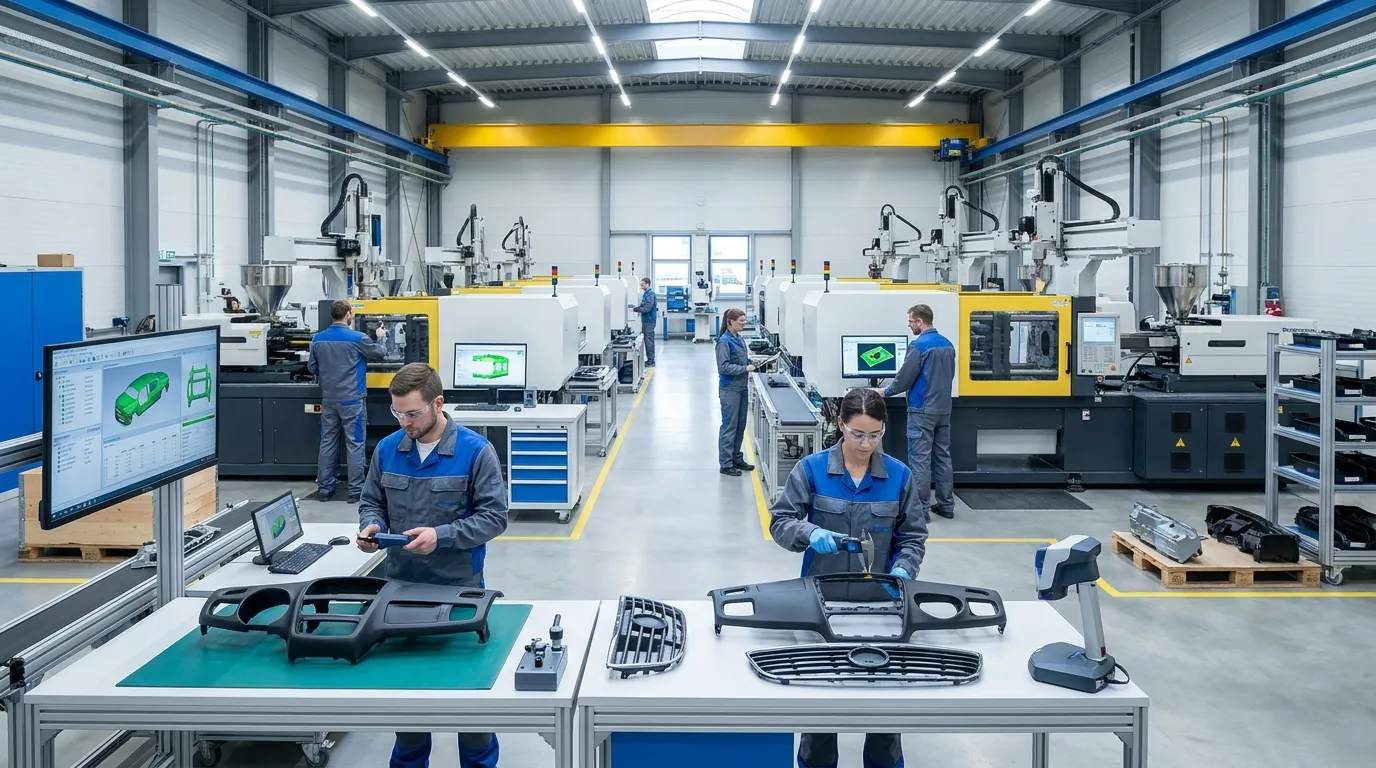
Automotive injection molding is widely used for dashboards, grilles, lamp housings, trims, klip-klip, and under-hood components because it supports repeatable high-volume production with tight dimensional control and strong surface consistency.
Automotive manufacturers use injection molding for both visible and functional parts. Interior components often include dashboards, center-console trims, air vent bezels, and door panels. Exterior applications include bumper trims, mirror housings, and front grilles. Under-hood parts may include clips, reservoirs, and electrical housings.
Many of these components require complex geometry and repeatable dimensions. Menurut Ikhtisar cetakan otomotif Fictiv, injection molding is widely used because it supports high production volumes with consistent part quality.
| Jenis Bagian | Contoh Umum | Prioritas Utama |
|---|---|---|
| Kosmetik interior | Dashboard trim, bezels | Permukaan akhir |
| Kosmetik eksterior | Grilles, mirror covers | Ketahanan UV |
| Bagian fungsional | Clips, rumah-rumah | Kesesuaian dimensi |
| Bagian di bawah kap mesin | Reservoirs, brackets | Tahan panas |
Visible parts usually have stricter cosmetic standards than hidden structural parts. A small weld line on an internal clip may pass inspection, but the same defect on a dashboard trim piece can trigger rejection.
Untuk perusahaan yang mengevaluasi Solusi pencetakan otomotif, it’s important to separate cosmetic and functional requirements early. The molding process may be similar, but quality expectations are not.
Which materials are best for automotive injection molded parts?
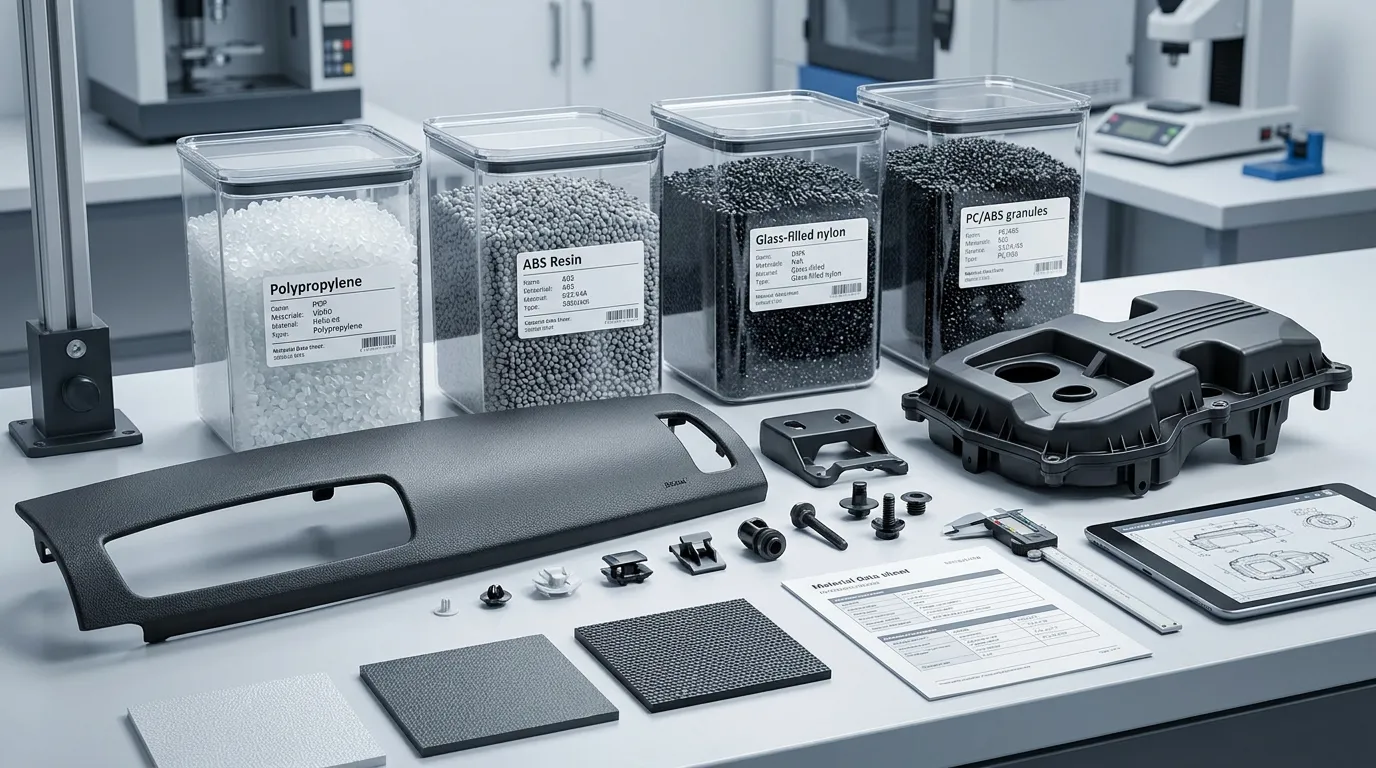
Material selection depends on heat exposure, impact requirements, UV stability, and cosmetic expectations. PP is common for lightweight interior parts, while reinforced nylon and PC/ABS blends are often used where higher strength or appearance quality is required.
Automotive plastics are selected based on operating conditions, not material popularity. A resin that works well for an interior trim piece may fail quickly near engine heat or direct sunlight. Material choice also affects shrinkage, finishing permukaan, and tolerance stability.
Bahan kelas interior
Polipropilena (PP) is widely used for interior trim because it is lightweight, cost-effective, and easy to process. ABS is also common for interior parts that require better surface appearance and rigidity. For premium visible surfaces, many manufacturers prefer PC/ABS blends because they combine appearance quality with better heat resistance.
ABS is not automatically the best choice for visible automotive parts. It works well in stable interior environments, but PC/ABS blends are often safer when heat exposure and cosmetic stability matter together.
Bahan di bawah kap mesin
Under-hood applications usually require higher heat resistance and structural strength. Nilon, also called polyamide (PA), is common for brackets, rumah-rumah, and clips exposed to elevated temperatures. Glass-filled nylon adds stiffness and dimensional stability but may increase mold wear.
Hubungan yang lebih luas antara perilaku perkakas dan resin tercakup dalam hal ini Panduan cetakan injeksi plastik lengkap.
| Bahan | Tahan panas | Kualitas Kosmetik | Aplikasi Umum |
|---|---|---|---|
| PP | Sedang | Baik | Trim interior |
| ABS | Sedang | Sangat bagus | Dash panels, bezels |
| PC/ABS | Tinggi | Luar biasa | Bagian premium yang terlihat |
| PA (Nilon) | Tinggi | Sedang | Komponen di bawah kap mesin |
| Nilon berisi kaca | Very high | Lebih rendah | Braket struktural |
Material selection should also account for long-term dimensional stability. A grille exposed to sun and seasonal temperature swings needs different resin behavior than an interior switch bezel.
What tolerances are realistic for automotive injection molded parts?
Automotive injection molded tolerances vary by material, ketebalan dinding, and geometry. Tight cosmetic and assembly-critical parts often require stricter process control, stable tooling, and validated inspection methods to maintain consistency across production runs.
Automotive tolerances depend on several variables working together. Penyusutan resin, keseimbangan pendingin, mold construction, and part geometry all affect final dimensions. Thin-wall parts with uneven geometry usually create more variation than simple, uniform components.
Tight tolerances are meaningless if the supplier cannot maintain stable processing conditions during production. Tool quality alone does not guarantee consistency. Process monitoring and dimensional inspection are just as important as mold precision.
Faktor-faktor yang mempengaruhi stabilitas toleransi
Parts with uneven wall thickness tend to cool at different rates, which increases warpage risk. Materials such as glass-filled nylon may hold dimensions more consistently but require tighter process control. Cooling layout also plays a major role in maintaining stable geometry.
A lamp housing is a good example. Even small dimensional changes can create assembly gaps or alignment problems. In many automotive applications, fitment consistency matters more than achieving the smallest possible tolerance number.
| Faktor | Dampak pada Toleransi |
|---|---|
| Penyusutan resin | Mengubah dimensi akhir |
| Keseimbangan pendinginan | Memengaruhi warpage |
| Kualitas cetakan | Memengaruhi pengulangan |
| Ketebalan dinding | Memengaruhi risiko distorsi |
| Variasi proses | Menyebabkan penyimpangan dimensi |
For readers who want deeper tooling fundamentals, ini Ikhtisar komponen cetakan explains how mold structure influences production stability.
How do automotive suppliers control cosmetic quality and surface finish?
Cosmetic automotive parts require tighter process monitoring because visible defects can lead to rejection even when dimensions are technically acceptable. Surface consistency, kilap, texture, and color stability are major inspection priorities.
Visible automotive parts often fail because of appearance variation before they fail dimensional inspection. Surface quality affects customer perception immediately, especially on dashboards, trim panels, and exterior grille assemblies.
Common cosmetic defects include sink marks, flow lines, weld lines, silver streaks, and gloss inconsistency. Suppliers reduce these risks by controlling mold temperature, injection speed, cooling uniformity, and material drying conditions.
Cacat penampilan umum
| Cacat | Penyebab Khas | Dampak Umum |
|---|---|---|
| Tanda tenggelam | Ketebalan dinding tidak rata | Depresi permukaan |
| Garis aliran | Aliran depan yang tidak konsisten | Coretan yang terlihat |
| Garis las | Titik pertemuan aliran material | Penampilan lemah |
| Variasi gloss | Pendinginan yang tidak merata | Ketidakcocokan warna |
| Lengkungan | Ketidakseimbangan penyusutan | Pemasangan yang buruk |
Texture consistency becomes especially important in multi-cavity production. A dashboard trim program with four cavities may produce visible variation if cooling or pressure differs between cavities.
Perusahaan mengelola Produksi cetakan otomotif usually inspect cosmetic parts under controlled lighting conditions to identify defects before shipment.
What quality control methods are used for automotive injection molding?
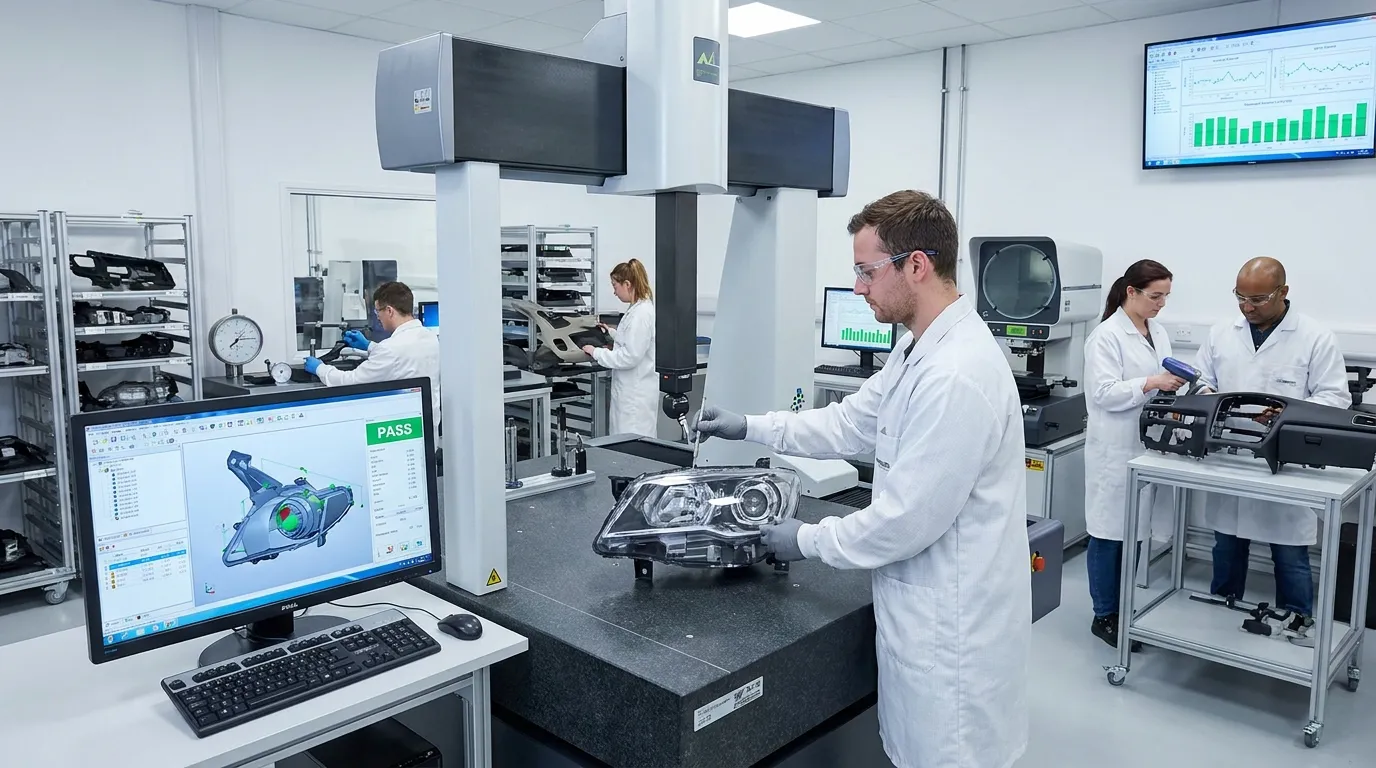
Automotive injection molding quality control combines dimensional inspection, process monitoring, and visual verification to reduce variation and prevent assembly issues during mass production.
Automotive suppliers use multiple inspection stages instead of relying on final checks alone. Quality control often starts with incoming material verification, then continues through sampling, inline monitoring, dan inspeksi akhir.
Inspeksi sebaris vs akhir
Inline inspection checks parts during production to identify variation before large batches are affected. Operators may monitor dimensions, penampilan, gate quality, and flash levels at regular intervals.
Final inspection focuses on dimensional verification and cosmetic review before shipment. Many suppliers also use statistical process control (SPC) to track process drift over time.
Peralatan pengukuran umum
| Metode Inspeksi | Tujuan |
|---|---|
| Kaliper dan pengukur | Pemeriksaan dimensi dasar |
| Mesin pengukur koordinat (CMM) | Pengukuran geometri kompleks |
| Sistem penglihatan | Inspeksi kosmetik |
| Pengukur Go/No-Go | Verifikasi perakitan |
| Perangkat lunak SPC | Pemantauan proses |
First article inspection is especially important for assembly-critical components. A lamp housing or snap-fit trim piece may pass individual measurements but still fail vehicle assembly if geometry shifts slightly across production runs.
Disiplin inspeksi yang digunakan dalam Alur kerja pencetakan presisi is also valuable in automotive production where repeatability matters.
Aliran Inspeksi QC Otomotif
- Verifikasi materi masuk
- Pengaturan dan pengambilan sampel cetakan
- Inspeksi artikel pertama
- Pemeriksaan dimensi sebaris
- Inspeksi permukaan kosmetik
- Validasi dimensi akhir
- Persetujuan pengemasan dan pengiriman
What causes warpage and dimensional inconsistency in automotive parts?
Warpage usually comes from uneven cooling, ketebalan dinding yang tidak konsisten, penyusutan resin, or unstable processing conditions. Even small distortion can create assembly gaps, masalah penyelarasan, or stress during installation.
Cooling layout is one of the biggest contributors to dimensional consistency. Research published on Arxiv highlighted how cooling-channel design affects shrinkage and part stability in injection molding applications.
A production run for an exterior grille is a common example. If one side cools faster than the other, the part may twist slightly after ejection. The distortion may appear minor during inspection but still cause visible fitment issues during vehicle assembly.
| Masalah | Kemungkinan Penyebab | Hasil |
|---|---|---|
| Memutar | Pendinginan yang tidak merata | Keselarasan yang buruk |
| Membungkuk | Ketidakseimbangan ketebalan dinding | Celah perakitan |
| Menyusutkan variasi | Inkonsistensi resin | Variasi ukuran |
| Cacat wastafel | Bagian tebal | Penolakan kosmetik |
Poor cooling design creates long-term production risks. That’s one reason automotive programs often spend extra time validating tooling before full production begins.
How should buyers evaluate an automotive injection molding supplier?
Automotive suppliers should be evaluated on tooling quality, process stability, kemampuan inspeksi, and production consistency rather than price alone. Poor process control often creates expensive downstream assembly and warranty issues.
A supplier with low pricing but weak process control can create far higher costs later through rejects, assembly delays, or warranty claims. Buyers should focus on production capability, disiplin inspeksi, and communication during tooling validation.
Ask suppliers how they handle dimensional drift, cosmetic inspection, and corrective actions. Their answers usually reveal more than a simple capability list. Experienced automotive molders should also explain how they document sampling, process settings, and inspection records.
Daftar Periksa Evaluasi Pembeli
- Tinjau prosedur inspeksi artikel pertama
- Tanyakan tentang pemantauan kualitas inline
- Verifikasi pengalaman dengan rakitan otomotif
- Periksa kemampuan inspeksi kosmetik
- Konfirmasi prosedur pemeliharaan cetakan
- Tinjau jadwal pengiriman dan pengambilan sampel
Programs with appearance-sensitive parts need extra supplier scrutiny. A dashboard trim supplier may require stronger cosmetic inspection capability than a supplier producing hidden structural clips.
Produsen dengan pengalaman dalam manufaktur yang berfokus pada inspeksi often apply tighter documentation and traceability practices that benefit automotive production as well.
Mendapatkan Langkah Selanjutnya dengan Benar
Choosing the right partner for injection molding automotive parts goes beyond tooling cost or machine capacity. Material behavior, kontrol pendinginan, stabilitas dimensi, and cosmetic inspection all affect long-term production performance.
Before approving a supplier, review how they handle validation, inspeksi, and process monitoring during full production runs. Ask for examples tied to parts similar to yours, especially if appearance or assembly fit is critical.
If your project involves complex geometry, visible surfaces, or tight fitment requirements, investing in stronger QC capability early usually prevents far larger production issues later.
Pertanyaan yang Sering Diajukan
What plastics are most common in automotive injection molding?
PP, ABS, nylon, and PC/ABS are among the most common automotive molding materials. Manufacturers select them based on heat resistance, impact performance, stabilitas dimensi, and cosmetic requirements for each specific component.
What automotive parts are usually injection molded?
Dashboards, grilles, lamp housings, trim panels, klip-klip, and interior bezels are commonly injection molded. The process supports high-volume production with repeatable dimensions and consistent surface quality.
What tolerances can automotive injection molding achieve?
Automotive molding tolerances depend on resin shrinkage, kualitas cetakan, keseimbangan pendingin, and part geometry. Tight-tolerance parts usually require validated tooling, stable processing conditions, and repeatable inspection methods.
How are automotive plastic parts inspected?
Automotive plastic parts are inspected using dimensional gauges, coordinate measuring machines, visual inspection systems, and inline quality checks. Many suppliers also use SPC tracking to monitor process variation during production.
What causes warpage in injection molded automotive parts?
Warpage is commonly caused by uneven cooling, ketebalan dinding yang tidak konsisten, material shrinkage, or unstable molding conditions. Distortion can create fitment problems even when individual dimensions appear acceptable.
How long does automotive injection molding production take?
Production timelines vary based on tooling complexity, sampling requirements, dan volume produksi. Tool validation and first article approval often add significant time before full-scale manufacturing begins.
Bagikan:


Ditulis oleh Sunshine
di Sunshine, Kami adalah produsen dan pemasok profesional komponen cetakan presisi, menawarkan berbagai produk untuk aplikasi stamping dan cetakan injeksi. Fokus utama kami adalah mencetak cetakan, pin dan lengan ejector, serta tiang panduan dan bushing. Dengan pemesinan CNC canggih, kontrol kualitas ketat, dan kemampuan produksi yang kuat, kami memastikan keandalan, suku cadang presisi tinggi, bersama dengan komponen standar yang tersedia untuk pasokan global yang cepat dan efisien.
BERITA
DAPATKAN LAYANAN
Dengan suku cadang berkualitas untuk memenuhi setiap anggaran dan staf ramah yang terlatih untuk membuat kunjungan Anda menjadi informatif dan tanpa repot.
